Select the stage for the toolkit

The process of management of contract involves:
- Defining the processes and procedures required to meet contractual obligations;
- Developing strong working relationships between stakeholders;
- Monitoring the performance of the Implementing Business Entity (IBE) to ensure alignment with project objectives and delivery of Value for Money (VfM);
- Identifying, monitoring, and managing risks associated with the project.
From the signing of the PPP agreement to the end of the contract term, the Government Contracting Authority (GCA) undertakes several key activities. These are carried out by a dedicated contract management team, which prepares a comprehensive Management of Contract Plan. This plan outlines:
- Key processes and procedures;
- Roles and responsibilities;
- Escalation mechanisms;
- Integration of service delivery, contract administration, and relationship management plans.
Organized across the various stages of the contract lifecycle, the Management of Contract Plan serves as a strategic tool to ensure that the IBE fulfils its contractual obligations and that VfM is consistently achieved throughout the project duration.
Stage I preparatory activities include the following activities:
- Setting up a management of contract team; and
- Developing a management of contract plan.
An effective contract management team is essential to achieving a project's long-term objectives. This team is primarily responsible for monitoring and reviewing the PPP project to ensure that the private party's performance aligns with contractual terms.
Establishing a contract management team requires careful planning and review. The skillset needed to manage a PPP contract differs significantly from the expertise required to plan, prepare, and negotiate the contract. Managing the risks assumed by the GCA and the associated liabilities is critical to maintaining value for money throughout the project lifecycle and ensuring its objectives are met.
To manage contracts effectively, the GCA must deploy a dedicated team with a deep understanding of project-specific challenges and PPP contract terms from an operational perspective. This understanding is key to determining the optimal team size and the timing and nature of the expertise required. Additionally, Bappenas Regulation 7/2023 highlights the important role of the PPP Node as a technical unit that supports the GCA in ensuring consistent and structured implementation of PPP contracts.
However, the establishment of a team will not, in itself, guarantee that the GCA will be able to maximise the PPP contract’s VfM. It should embed the following characteristics to facilitate achieving and maximising VfM:
- Mandate: The team should have a clear mandate to act on behalf of the GCA and act as the GCA’s representative within the public regulatory environment. A representation may be achieved through internal delegations or institutional arrangements within the GCA or a specific form of legislation/regulation may establish and empower the team (for example: a PPP Node).
- Contractual standing: In addition to a mandate, the team must be empowered within the PPP contract terms to act as the GCA’s representative and to exercise specific powers or rights under the contract.
- Resources: The team must have the human and financial resources to fulfil their mandates and contractual rights effectively and efficiently.
The specifics of the mandate, contractual standing, and resources required will differ from sector to sector and from one project to another. Factors that will influence these functions include (a) scale of a project or program of projects: A useful metric is the value of the assets created by the PPP (b) Administrative complexity of the projects, such as whether they are cross-border or cross-agency in jurisdiction and (c) Extent of GCA-retained risk in the contract (determined by considering the financial consequences accruing to the GCA of a risk materialising).
It is common in PPP projects for majority of the project team of the planning, preparation, or transaction stages to leave the project following the project award or financial close. Getting the management of contract team ready prior to the end of the transaction stage can therefore help with transition and prevent loss of knowledge about the project. Knowledge can be transferred to the management of contract team prior to the exit of the project team.
GCAs should adopt a three-tiered governance structure for management of contract.
- Partnership Committee – Strategic Oversight
- Management of Contract Board – Tactical Coordination (supervisory level)
- Operational Management Team – Service-Level Execution (day-to-day execution level)
This includes defining governance structures and establishing procedures for monitoring and reporting. It also includes understanding risk allocation and who is responsible to manage the risk. Ensure diversity in the three-tiered governance structure to bring various perspectives and skills to decision-making. This includes ensuring women and men are represented. The recommended roles and responsibilities are:
The Partnership Committee is at the highest level; it shall ensure that the project runs smoothly and that the partnership relationship is successfully executed. Communication with all stakeholders is channelled through this committee and any issues that need resolution are addressed at this committee. The Committee shall meet quarterly, however should the need arise, the Committee shall meet on an ‘ad hoc’ basis. The objectives and functions of the Partnership Committee are to:
- Strategically lead the project.
- Provide guidance to ensure that long-term issues are considered and resolved, including outstanding grievances.
- Ensure effective communication and inclusive stakeholder engagement takes place at all levels.
- Ensure that the contract’s objectives are met over the full term of the contract.
- Ensure that an ethos of working in ‘partnership’ is developed and maintained.
- Ensure that the project is aligned with both parties’ (GCA and IBE) business or service plans.
- Consider and report on any changes in legislation.
- Agree on proposed efficiencies and changes.
- Set year-on-year improvement targets, if appropriate and
- Promote best value through the management of whole project life costing through innovation and service improvements.
Partnership committee includes: Senior Leadership Level GCA representatives/ Members; Oversight officials from the Government; Officials from Province & Local authorities; Key members from the Management of Contract Board; Nominees from IIGF; Chairman/ CEO of the IBE; and other key stakeholders like PPP Node, Sustainability Specialist, public representatives, CSOs, etc. The partnership committee should aim to include a diverse and inclusive membership, reflecting the needs of the project sector while ensuring opportunities for qualified women and men.
The Management of Contract Board shall monitor service delivery against service levels & Key Performance Indicators (KPIs) and ensure that the daily contractual matters are dealt with as efficiently as possible. The Board shall meet once a month. The objectives and functions of the management of contract board are:
- Review, discuss and agree on issues arising from the monthly monitoring report.
- Review the payment report and agree on payments due.
- Review the past and future financial performance of the project.
- Resolve issues with regard to production of information.
- Take a forward view of the project.
- Identify efficiencies and necessary changes.
- Record/discuss issues affecting the contract, e.g., compensation events, delays, time extensions, grievances, degree of inclusive stakeholder engagement, safety, access and affordability of services.
- Review areas of conflict.
- Ensure that the partnership board is briefed and actions are taken and
- Promote working in partnership.
Management of Contract board includes: : Supervisory level contract managers from the GCA representing Technical, Financial and Legal wings; PPP Node Officials; Independent Expert; Specialist Consultants; Invited senior representatives from other Government department/ ministries relevant to the project; Senior Officials from the Operational Management Team; and Supervisory level representatives of the IBE. The management contract board should strive to include a diverse and inclusive membership, reflecting the needs of the project sector while ensuring opportunities for qualified women and men.
The Management of Contract Board reports to the Partnership Committee and it leads the Operational Management Team.
The Operational Management Team shall monitor and discuss performance, and manage contractual obligations and any changes driven by the contract or outside the contractual limits that would affect the project. The board shall meet the management of contract team on a regular basis - at least weekly, as a good practice. The objectives for operational engagement are:
- Early identification of issues, including those related to environmental, social and governance (ESG) compliance, inclusive stakeholder engagement, safety, access and affordability of services.
- Produce or review monitoring reports and payment reports (if produced by the IBE).
- Review financial performance of the project and of the contractual parties.
- Discuss and, where possible, resolve minor operational issues, including grievance redressal.
- Ensure that contractual parties are aligned regarding the service level required.
- Promote working in partnership and
- Implement changes when necessary and report back on the same.
Operational management team includes: Field project managers from the GCA representing Technical, Financial and Legal wings; PPP Node Officials; Independent Expert; Specialist Consultants; operational officials from other Government department/ ministries relevant to the project; Field level representatives of the IBE and a representation of CSOs or community where necessary (for example: project that require land acquisition). The operational management team should aim to include a diverse and inclusive membership, reflecting the needs of the project sector while ensuring opportunities for qualified women and men.
The Operational management team reports to the Management of Contract Board.
The governance framework is designed to establish clear lines of authority and allocate responsibilities to ensure efficient management of contract. Each PPP project should ideally be supported by an Operational Management Team, comprising field officers responsible for the day-to-day oversight of project activities. This team works closely with the project implementation unit of the IBE to ensure effective execution on the ground. Their efforts are further supported by consultants and independent experts who monitor project progress and compliance.
At a supervisory level, the Contract Management Board oversees a portfolio of PPP projects on behalf of the GCA. The Board provides tactical support, reviews project performance, and resolves issues escalated by the Operational Management Team. It also liaises with senior officials at the IBE and coordinates with other government departments to facilitate smooth implementation.
At the strategic level, the Partnership Committee offers high-level guidance and addresses disputes that remain unresolved at the Board level. It is also responsible for approving financial decisions and engaging with top-tier authorities within the IBE to ensure alignment with broader policy objectives.
The engagement matrix between the GCA and IBE is as follows:
| Tier | GCA | IBE |
|---|---|---|
| Partnership Committee |
|
|
| Management of Contract Board |
|
|
| Operational Management Team |
|
|
Templates
Job Descriptions
Independent Expert - Terms of Reference
Training is an important part of the GCA’s activity of establishing a management of contract team. Resources involved in the management of contract shall be adequately trained to effectively and competently execute their roles and responsibilities. Inexperienced or less experienced resources pose significant risk to effective management of contract, public sector accountability, and successful project outcomes.
When recruiting and mobilising the team, the GCA shall assess the level and extent of staff training that might be needed. This may depend on the individual’s/resource’s past PPP experience and the knowledge obtained within the field/sector. Therefore, the GCA shall identify initial and ongoing training requirements for all kinds of resources of the management of contract team, and aim to include male and female participants in the training. Additionally, records of training delivered should be kept, with participant lists disaggregated by gender, organisation, and other relevant particulars.
Training curriculum, depending on the resource’s requirements and past experience, may include:
- PPP project or PPP contract-oriented training e.g., Introduction into PPPs & the project life cycle, management of contracts (features, stages etc.), regulatory compliance including ESG and inclusive stakeholder engagement, establishment of a grievance redress mechanism, mobilisation & handover, payment mechanism & its application, risk analysis, performance monitoring, contractual change & variation management, benchmarking, market testing, toolkit usage etc. and
- General training e.g., basic management of contract principles, project & time management skills, negotiation & communication skills, probity & compliance, dispute & issue management, general commercial skills, human resource management and disputes resolution, gender equality and awareness about the inclusion for people with disability, inclusive and respective workplace engagement and support, and relevant computer software.
Templates
Management of Contract Training
Training Requirements
The management of contract plan shall be written in plain language and shall explain the GCA’s duties and obligations, as well as steps to be taken to successfully monitor the IBE’s progress and delivery. The plan shall also provide processes and procedures that need to be followed between the organisational structures and departments. This is typically the case for internal procedures involving different departments within the GCA’s administration, for example the operational management team and accounts department for the payment procedure. In case of projects involving numerous public stakeholders such as waste management and water supply, the scope of the plan may be broadened to manage the interaction amongst key public stakeholders.
The plan shall always be read in conjunction with the signed PPP contract and must be aligned with the processes contained within the contract. The plan shall not be substituted for the contract itself. The plan shall be practical and relevant to both the day-to-day and the longer-term management of the contract. The main components of the plan shall be as follows:
- Steps for taking action: Including the most immediate and critical actions of the Operational Management Team in-charge (Contract Director) and relevant team members while managing the contract. Actions are set out in the context of a clear understanding of the commercial intent of the contract parties and the relevant commercial, legislative, regulatory, and policy background.
- Alignment of resources: The plan shall enable the contract director to identify the resources required to perform necessary tasks and manage the most time-critical and materially significant risks at various stages during the project life cycle.
- Provide support to governance: The plan shall support the GCA’s governance practices including communications, accountability, and decision-making processes.
- Tools and processes The plan shall provide a single point of reference for management of contract tools and processes.
- Adaptability: The plan shall be a dynamic/living document and shall be updated regularly to ensure that it remains relevant throughout the project life cycle.
Templates
Management of Contract Plan
Samples
Management of Contract Plan for a Sample Project
Contents of a Management of Contract Plan
Development of a management of contract plan is one of the first steps undertaken by the management of contract team (Team). The contents of the plan are outlined below:
This is an introductory section covering purpose of the plan, approach, roles, and responsibilities. The Team will detail out in brief the contents of the plan, target audience, users and how the plan is used for implementing the PPP.
In the sub-section on approach, the Team will detail the methodology adopted for preparing the plan and the approach for modifying the plan to reflect changed scenarios during the term of the contract.
- Details on the project cost and proposed financing arrangements (will be updated after financial close); and is an output of the preparatory stage of the proposed infrastructure provision.
- Conditions precedent stage;
- Obligations of the GCA;
- Obligations of the IBE;
- Revenue structure for the project: User charge/ Availability Payments/ Hybrid/ Others (Land value capture, commercial exploitation, etc.);
- Guarantee and government support arrangements;
- Details on performance security, insurance, etc.
The section should provide details on the objective behind entering the PPP contract, benefits to the GCA from the project and list out the key motivation for implementing the project as a PPP. The Team may refer to the Preliminary Studies and Pre-Feasibility Studies prepared for the project for listing out the objectives of the project.
Key timelines for the project, delineating start and end dates for contract stages – conditions precedent, construction, service delivery, etc.;
The section should provide details on the objective behind entering the PPP contract, benefits to the GCA from the project and list out the key motivation for implementing the project as a PPP.
- Output specification: It should include the performance targets, key performance indicators, benchmarks, target values, penalty system etc.
- Performance monitoring procedure: It is based on the methodology listed in the contract, it includes the details on measuring the performance, timing/ frequency of measurements, modalities for calculations, etc.
- Payment procedure: It includes payment details comprising fixed and variable payments, modalities for adjusting the payment, procedure for levying penalties or payment for incentives, etc. It also specifies the interlinkages with the output specifications.
The performance management system is fundamental to the contract management process since it is the basis of all payments to service providers and any penalties which may be imposed are also estimated through this process based on the terms agreed to in the contract
The Team will need to have a clear understanding of the performance requirements at each stage of the project lifecycle. Understand the performance measurement framework in terms of Key Performance Indicators (KPI) including monitoring of grievance and follow up on issues encountered. Thereafter, a reporting and monitoring framework needs to be put into practise.
The section will also list out the methods for close monitoring of KPIs and institutionalise early warning systems to identify issues for corrective actions including issues or grievance raised via a complaint handling mechanism. During the process of implementation, target KPIs may also be periodically redefined and updated. The modality for such reviews also needs to the included in this section.
- Risk management plan should identify option for managing risks, allocated responsibilities to individuals to manage such risk. It should also define the procedures to control such risk in terms of escalation procedures. At the same time, the resources required for managing risks in terms of both material and human resources should be defined in the risk management plan. Effective documentation of the plan is critical to it being understood by all stakeholders and implemented efficiently at the time a risk arises. Risk management in terms of monitoring would include not only monitoring the risk identified in the risk management plan but new risks that are likely to arise during the project lifecycle.
- Risk monitoring and reporting structures would depend on duration, size and complexity of PPP projects. As in-case of performance monitoring, risk monitoring also is more critical where the fiscal impact of the project is higher as in case of VGF projects, Availability Payment based projects. The intensity of risk monitoring also depends on the nature of services provided by the project, nature of ESG actions and degree of impacts.
- As important as monitoring of risks is the process of reporting such risks and escalation procedures which should be clearly defined in the risk management plan. Risks may arise from issues or grievances raised via a complaint handling mechanism or similar feedback system established under the project as well as risks identified against ESG risk register tool.
Risk is the likelihood of an event occurring which would cause the actual circumstances and outcome of the project to be different from that assumed during project development phase. The objective of the risk management process is to minimize the probability of occurrence of risk and its potential impact on the project.
Risk management is the systematic process of planning, identifying, analysing, responding to, and monitoring project risks. The risk management process should involve processes, tools, and techniques that will assist the Team in minimizing the probability and consequences of adverse events as indicated and appropriate within the context of risk to the overall project objectives of cost, time, scope, and quality.
-
Risk register
The Team will need to prepare a risk register that lists the risks, sensitivity of the risk (high/ medium/ low), risk bearer, risk monitoring methodology, the risk management strategy adopted, and anticipated revised risk sensitivity (post-strategy adoption, high/ medium / low). The risk register can be adopted from the project risk matrix developed during the pre-feasibility study stage of the project with suitable updates based on its treatment in the PPP contract. The risk register is as follows:
| Risk Type | Sensitivity | Risk Bearer | Risk Monitoring | Risk Management Strategy Adopted | Anticipated Revised Sensitivity |
|---|---|---|---|---|---|
| H/M/L | H/M/L |
| Risk Type | Sensitivity | Risk Bearer | Risk Monitoring | Risk Management Strategy Adopted |
|---|---|---|---|---|
-
Risk monitoring and response tracking
- Dates and action taken to manage the risk
- Action taken when the risk event occurred
- Subsequent action taken
- Update the risk management plan with relevant information based on actual response to risk
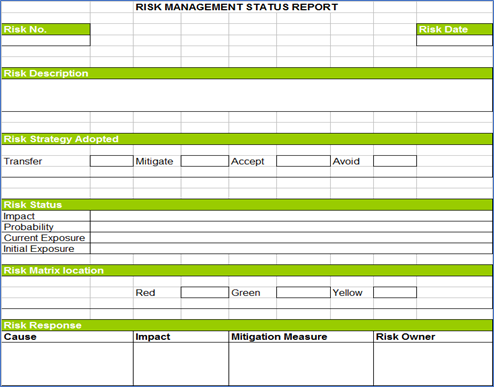
Risk monitoring information should be captured in a risk monitoring status report which at the minimum should include:
Risk Monitoring Template should be included as a part of the Contract Management Plan to ensure uniform tracking and reporting of information. The risk monitoring template allocates one page per risk and it maintains a record of that risk during the life of the project. A typical risk monitoring template will include the following details:
-
Risk hierarchy and escalation procedure
This section will need to detail the procedure to be adopted by the Team for managing risks and escalations in case a risk is manifested. The section will provide guidance on how risks can be managed with triggers for escalation based on its categorisation as High/ Medium/ Low.
| Risk Hierarchy Level | Risk Type | Description | Detection Method | Initial Responsible Party | Escalation Threshold | Escalation Path |
|---|---|---|---|---|---|---|
-
Risk management plan audit log
This section maintains a record of risks that occurred during the implementation of the contract and how it was managed. This record helps the Team in recategorization of risks based on its frequency of occurrence, severity, and impact. Sample template includes the following details:
| Risk Name | Details on occurrence | How it was managed | Lessons/ feedback | Entry approved by | ||
|---|---|---|---|---|---|---|
|
Date/ time:
Brief description:
Severity:
Impact
|
Brief details with details on escalations | < Management of Contract Board > | ||||
- Mutual trust based on an understanding of mutual benefit: The parties to the agreement should view the PPP agreement as a mutually beneficial enterprise;
- Understanding objectives: The GCA and IBE must understand and respect the independent objective of each entity and the shared project objectives;
- Open Communication and information sharing: The GCA should foster an environment of sharing information with and obtaining information from the IBE on matters directly or indirectly related to the project.
Relationship management aims at creating a harmonious relationship between the contract parties. The key elements of an efficient relationship are:
The key to developing an effective long-term relationship is the establishment of a collaborative working relationship, together with systems and communications that actively support and enhance the relationship throughout the life of the project.
- Strategic level communication led by the Partnership Committee would focus on discussing the partnership, its management, and any initiatives within it that they could promote or initiate. They would promote the relationship and commitment to a healthy relationship by leading through example.
- Business level communication led by the Management of Contract Board is more formal and structured. Changes to the contract are managed at this level and any issue that arise will be dealt with here should be dealt with through effective communications.
- Operational level where the actual service delivery occurs and is monitored by the Operational Management Team. Day-to-day problems in the delivery of services may be resolved here; if this is not possible, they can be escalated to the Management of Contract Board.
Communication is the essence of a good working relationship. Such communication happens in the following ways:
Successful relationships in contract management are typically spearheaded by seasoned management staff by establishing a collaborative rather than a confrontational approach to contract management.
-
Governance arrangements
The section will detail governance arrangements adopted for the project. It should present the key members of the GCA involved in contract execution and their respective roles and responsibilities. The allocation of roles, responsibilities and delegation of powers will need to align with the three-tiered governance arrangements comprising – Partnership Committee, Management of Contract Board and Operational Management Team. In addition, the section will list the relevant government agencies, independent experts, specialist consultants and other entities associated with the project.
This section will also include details on the counter party from IBE, their contact details, designations, and levels mapped across the three-tiered governance hierarchy, names of the specialist consultants/ project management consultants deployed by the IBE, etc.
-
Contract Review Meetings and communication plan
- Frequency of contract review meetings
- Persons required to attend such Contract Review Meeting
This section should define
Purpose of such meeting should be to facilitate information sharing and enable issues to be red flagged early on and thereby minimizing dispute situations
-
Issue management
Mismatches between the expectations of GCA and IBE and other related parties may lead to issues and disputes during execution which may cause delays in project execution. Timely resolution of any dispute will ensure that user interests are protected and GCA is achieves the project milestones in time.
Identification of issues, recording it and resolution by the Operational Management Team is an important part of relationship management. The process involves maintaining a list of issues observed and the action taken to resolve the issue. The following is a sample of an issue and actions tracker (Tracker). The Tracker includes fields for describing the issue, identifying its impact on the project, allocating a priority for its resolution, assigning responsibilities (GCA and/ or IBE) for resolving it, recording actions taken towards resolving it and status.
Issues and Action Tracker sample:
| Issue ID | Date raised | Raised by | Issue description | Project impact | Priority | Agency to resolve | Action taken to date | Status |
|---|---|---|---|---|---|---|---|---|
| < describe issue > | < in % or kms, area, etc > | H/ M/ L < based on criticality and project impact> | < GCA/ IBE/ other related Parties (Person name, etc)> |
< list actions: meeting references, completed actions, pending items >
< Ideally tagged to a file recording a trail of discussions and documents >
|
< Resolved/ Pending/ Escalated to Dispute Resolution > | |||
The Tracker is maintained by the Operations Management Team. Both GCA and IBE can contribute to the issues as part of their regular review meetings. This Tracker is reviewed by the Management of Contract Board in its monthly review meetings to identify areas of intervention and facilitation.
-
Escalation procedure and dispute management
- The team member observing the issue will highlight concerns to the other party verbally and request intervention to address the issue within [3] days. An issue may also be raised and documented for follow-up by a third party (that may include an individual or group who has/have been adversely affected by the project. They will report to the operational team via an established mechanism for grievances that is accessible through multiple channels (e.g., in person, email, web-based platform, etc;
- If the issue remains unresolved, Senior field team members from GCA (or IBE) can make written note of issue and initiate discussion with to remedy issue;
- If the issue is not resolved within a period of [7] days, the party highlighting the issue can call for a meeting with an agenda to prepare a plan for addressing the issue in the next [15] days;
- If the issue continues to remain unaddressed in the timeframes above, the Management of Contract Board will try to address the issue and put in place an action plan for timely resolution within a period of [15] days;
- If issue is not resolved within timeframes above and those specified in contract (whichever is earlier), escalation procedure will involve issuing written notification to initiate the Dispute Management Procedures starting with Consultation and Mediation as per contract terms;
-
The Consultation and Mediation process will be initiated under the supervision of the Management of Contract Board;
- In case of technical issues – the issue will be referred to the independent expert
- In case of non-technical issues – Negotiations will be led by the Management of Contract Board
- In parallel, the Partnership Committee will be informed of the unresolved issue for its intervention via Fast Track Dispute Resolution if the issue is not resolved while the procedures continue to be in force;
- Issues remaining unresolved will be finally resolved through Arbitration and Conciliation either through Arbitration or by Courts based on the provisions in the PPP contract.
The issue escalation procedure is also sometimes referred to as the grievance redressal mechanism. This includes the following steps:
The following flow chart indicates the escalation flow of issues in a typical PPP contract. Level I is normally led by the Operational Management Team and the Levels II & IV is led by the Management of Contract Board with active participation by the Operational Management Team.
The Partnership Committee will oversee the resolution of the issue while maintaining a channel of communication with the other party to resolve the issue without resorting to implementing the dispute resolution procedures (Level III).

This section on escalation and dispute resolution will be appropriately modified based on the provisions in the PPP contract and the anticipated nature of the grievances.
The objective of this section is to develop and implement contract administration policies and procedures. Such policies and procedures should support the other contract management functions in ensuring VfM while meeting the project objectives.
-
Detailed stage management plans
This section of the plan can be updated in as a project proceeds through the stages. The Team will need to prepare the stage management plan for Conditions Precedent stage at the time of preparing this plan. Thereafter, the stage management plan for Construction stage can be developed during the conditions precedent period and completed as a key stage transition activity before the start of construction on site. For convenience, the detailed stage management plans can be annexed to this Management of Contract plan and annexes can be added as the project transitions to the next stage.
Refer to the sections on Conditions Precedent, Construction, Service Delivery and Transfer stages for detailed contract administration practices to be followed during the stage.
-
Financial administration
Financial administration involves operationalising the payment mechanism which has been defined in the contractual terms and detailed in the contract management plan. The payment mechanism is at the core of the contract, as it puts into financial effect the allocation of risk and responsibility between the local authority and the service provider. Rigorous implementation of payment mechanism which makes appropriate deductions for shortfalls will help incentivise performance
-
Variation management
- Day to day operational variations which could either be a small variation with no significant impact on project outcomes or a larger variation with a significant impact on project outcomes. The process and procedures for managing such day-to-day variations should be clearly laid down;
- Known-unknowns are those events the nature of which is known however the likelihood of when it would occur if it does is an unknown. Example of the same is change in project scope;
- Unknown- Unknowns are those events where both the nature and likelihood of the event is unknown. Example of the same is Force Majeure events.
- Adhering to procedure and process for contract variation specified in the contract;
- Defining clearly the roles and responsibilities of the members of the contract management team involved in the variation management process;
- Documenting in detail all interactions between contracting parties and ensuring effective communication of shared understanding;
- Updating regularly the contract to ensure that it reflects the amended contractual terms
Within contract administration, variation management plays an important role in minimizing conflicts that are likely to arise between contracting parties due to changes in contractual terms.
Variation management involves managing contractual variations during the implementation phase. Such variations could fall in to three basic categories
The success of the variation management process would require the following:
An essential element of variation management is managing transition in the project. The transition happens as the project moves across the stages from conditions precedent stage all the way to transfer stage. The strategies adopted for managing variation will depend on the stage of PPP project and the specific circumstances necessitating such change.
-
Reporting requirements
- What is to be reported
- Format of Reporting – written or verbal
- Frequency of reporting
- Source of Information
This should include procedures and formats for reporting to be done by the Operational Management Team and IBE to the Management of Contract Board and other government agencies. The Team needs to prepare a reporting list covering:
-
GCA risk cover management
PPP contracts include provisions for submission of performance securities, obtaining project insurances, warranties, etc from the IBE. These submissions form the first line of risk cover to a GCA in event of any defaults by the IBE or due to untoward events. The Operational Management Team is required to keep a record of these submissions by the IBE, assess its conformity with the PPP contract, and ensure that the risk cover is always valid. The sample template for managing the risk cover is as follows:
Performance bonds/ security
| Type | Amount as per contract | Dates from/ to | Submission from IBE – details | Accepted, verified | GCA actions/ follow-up |
|---|---|---|---|---|---|
| < Construction/ service delivery/ transfer bonds > | IDR xxx mn | < ddmmyy to ddmmyy > | < Issuing bank/ dates/ amount/ validity > | < Verified by/ details on verification with clause xxx in PPP contract > | < when to initiate renewal/ encashment of security/ reason for encashment/ replacement/ renewal > |
Insurance:
| Type | Cover as per contract | Dates from/ to | Submission from IBE – details | Accepted, verified | GCA actions/ follow-up |
|---|---|---|---|---|---|
| < Contractor all risk policy/ Insurance as per contract/ Climate risk insurance > | IDR xxx mn | < ddmmyy to ddmmyy > | < Issuing insurance agency/ dates/ amount/ validity/ special conditions/ rights of subrogation/ other policy details > | < Verified by/ details on verification with clause xxx in PPP contract > | < when to initiate renewal/ reason for claim/ replacement/ renewal > |
Warranties:
| Type | Requirement as per contract | Submission from IBE – details | Accepted, verified | GCA actions/ follow-up |
|---|---|---|---|---|
| < Certificates on IBE formation/ Board of Directors warranties/ Company secretary certification > | < Details as per clause# > | < submission dates/ details/ special conditions/ etc > | < Verified by/ details on verification with clause xxx in PPP contract > | < when to initiate renewal/ followup/ renewal > |
-
Knowledge management
One of the key objectives of contract maintenance is ensuring continuous availability of project related knowledge and information through the project lifecycle. Knowledge management system and processes should consider the complexity of project, contract duration and the number of stakeholders requiring access to the contract documentation process.
Maintenance of documentation on service delivery and performance to the GCA should include documents related to ESG compliance. For instance, environmental and safety records (compliance documentation), and social compliance documentation (records of consultations and engagement of women and marginalized groups, including indigenous people and people with disabilities in the project at various stages [including their nature of participation and roles], number and nature of grievances and resolutions, and impact of the project on these groups [in all contractual stages]).
To ensure continued service delivery, the contract administration function should define a contract expiry strategy which would come into effect at the end of the contract term. It should define the resources and procedures for ensuring continued service delivery after contract expiry. Developing, testing, and periodically updating a contract expiry strategy is important in ensuring smooth transition of services and continuity of service at the end of the concession term.
-
Recruitment of consultants/ experts
Many PPP contracts require services from specialist consultants to facilitate implementing a project. These include – independent experts, environmental and social specialists, auditors, survey agencies, etc. This section will need to list-out the requirements based on the PPP contract and propose a plan for implementing it.
-
Management of Contract Plan Review
This section should include review procedure for updating the management and the frequency of review.
- Disruption in service delivery not on account of IBE default
- Disruption in service delivery on account of IBE default
- Default by IBE but no disruption in service delivery
- Business Continuity Plan: It aims at mitigating the impact of service delivery disruptions on the key stakeholders. It consists of a series of individual plans for managing each service element of the project. It is important that the contracting parties have a basic understanding of one another’s plans for these events to ensure smooth execution if such a situation arises.
- Step-in Plan: It allows for the contracting party, under exigent circumstances, to “step-in” and temporarily takes control of project facilities to ensure continued service delivery. Provisions for “step-in” are normally defined in the contractual terms.
- Default plan: It sets in when the default clause of the contract is invoked. Since a default plan is typically invoked at short notice and under high pressure situations, it needs to be concise, easily understood, and accessible to all concerned persons.
Contingency plans should assist the GCA is managing and minimizing the impact of risks which have not been effectively contained. Contingency planning is especially important to PPP projects as it may not always be possible to fully transfer the responsibility of service delivery and associated risks to the IBE. The ultimate responsibility of service delivery for PPP projects will still rest with the GCA. The impact to end users because of non-fulfilment of contractual terms by IBE as well as reputational impact to GCA is significant. Hence detailing contingency plans are an essential element of all contract management plans.
Contingencies can arise under the following circumstances:
The contingency plans should define procedures to manage each of these contingencies. Broadly contingency planning consists of the following types of plans:
This section will define how project documents are managed, updated, and stored. Documents for a PPP contract can be categorised into the following. The hierarchy of documents forms an important part in the interpretation of the contract. The documents may be organised as follows:
-
Documents with the highest hierarchy at the time of Preparation Stage:
- PPP Contract and its schedules;
- Letter of award and related communication leading to the formation of the IBE;
- Details on the formation of IBE and related warranties;
- Minutes of Meetings during negotiations;
- Response to the request for proposal and request for qualification submitted by the IBE;
-
Documents with equal hierarchy with above as the contract evolves through the stages:
- PPP contract amendments;
- Correspondence between the GCA and IBE;
- Notices issued, response to the notices and its resolution;
- Right of way, site documentation, assets handover pursuant to various clauses of the contract;
- Various submissions with respect to the contract, example performance securities, insurance, etc;
- Certificates and permissions issued by the GCA with respect to transition of stages, example notification of completion of conditions precedent, commissioning date, etc;
- Regulatory notices and approvals, example – notification to levy user charges
- Permits and approvals obtained from various authorities
- ESG compliance related
-
Operational documents during the implementation of the project and next on the hierarchy:
- Feasibility study submitted by IBE;
- Lender approved financial model;
- Detailed engineering drawings and working drawings;
- Progress reports submitted by the IBE;
- Progress reports submitted by the Independent Expert;
- Permissions and approvals issued by the GCA;
- Reports submitted as per contract;
- Annual financial statements;
- Inclusive stakeholder engagement records;
- Public grievance monitoring, management, and public disclosures
-
Documents connected with the above but entered with other entities:
- Lender agreements and financing package – loan agreement, security documents, tripartite agreements - escrow arrangements, substitution agreement, etc.
- Government support and Guarantee agreements;
- Construction agreement;
- Service/ O&M agreement;
- Facility management agreement;
- Insurance policies;
- Performance bonds;
-
Documents related to formation of the IBE:
- Memorandum and articles of association document of IBE;
- Shareholders agreement;
- Warranty letters issued by the Chairman of the IBE Board of Director and Company Secretary;
-
Documents related to authority of the GCA to enter the PPP:
- Approval from the Minister;
- Legal opinion of the GCA to enter into the agreement;
- Approvals from various authorities as per state support arrangements;
-
Reference documents:
- Project preliminary study;
- Project pre-feasibility study;
- Project preparation documents, including land acquisition and resettlement plans (LARP), and environmental and social impact assessment (ESIA), and gender action plan;
- Procurement transaction documents;
- Pre-bid meeting minutes;
- Details on the bidding process – shortlisted bidders, bidders responding to the RFP, notice to unsuccessful bidders, etc.
- Affordability and public objection to related fees
- Administrative risks, e.g., land acquisition, resettlement, and construction permit
- Local residents and communities objecting to the project / project-affected parties
- Lack of representation across gender, persons with disabilities and/or disadvantaged groups and
- Operational staff, such as teachers in the case of a school project, objecting to the project.
The GCA itself may not be the end-user in several projects. In such cases, the GCA should involve end-users at an early stage because inadequate consultation of stakeholders (such as project-affected parties, persons with disabilities, women, indigenous peoples, and/or specific social or economically disadvantaged groups, consulted during public consultations in the planning and preparation stages in line with the applicable laws, regulations, and ESG standards) can lead to delays in project implementation or make management of contract challenging. It can also result in underestimation of key social or environmental risks and limit the ability of both the GCA and the IBE to mitigate complex or sensitive risks, such as:
It is good practice to establish a stakeholder database disaggregated where possible by gender, disability, and other identities or relevant factors at the start of the project and to update it regularly throughout the contract lifecycle. Furthermore, a dedicated and accessible grievance mechanism and a communication channel can facilitate two-way communication and the dissemination of key or controlled messages. An effective grievance mechanism is one that clearly outlines the steps in the grievance process, is accessible, has multiple channels for reporting (e.g., a web platform, email, in person) and in a language of the target communities (see section on escalation procedure and dispute management). Given that the construction stage is often the most sensitive when opponents may actively challenge the project or influence local sentiment, it is also good practice to appoint an experienced focal point to design and implement an inclusive and culturally appropriate communication and engagement strategy. This strategy should reflect ESG principles and be tailored to reach diverse audiences using accessible formats and inclusive engagement methods.
- Establish contract management team
- Arrange staff transfers/ appoint staff
- Prepare management of contract plan
- Progress report on achievement of CPs
- Conduct regular review meetings
- Notify financial close and transition to Construction stage
- Stakeholder engagement records and documentation
- Conduct quality assurance review
- Prepare performance report
- Review and revise the PPP Contract management plan
- Conduct regular review meetings
- Establish escalation procedure and dispute management (or grievance redressal mechanism)
- Conduct quality assurance review
- Prepare performance report
- Review and revise the PPP Contract management plan
- Conduct regular review meetings
- Ensure functioning escalation procedure and dispute management (or grievance redressal mechanism)
- Evaluate exit options
- Review PPP Contract expiry conditions
This section should present the implementation schedule of various stages in project implementation, the target dates for achievement of the same, responsibility assignment to members of the contract management team and project team and the defined institution budget for each of these steps. These steps may be expanded to take on additional key tasks to reflect the nature of the project.
| Key Tasks | Target Date | Responsibility | Institution Budget |
|---|---|---|---|
|
1. Preparation stage
|
|||
|
2. Conditions precedent stage
|
|||
|
3. Construction stage
|
|||
|
4. Service delivery stage
|
|||
|
5. Transfer stage
|
This section should include detailed stage management plan for the contract stages. For details, refer to detailed stage management plans in Contract Administration.
The Conditions Precedent (CP) stage begins at once after the execution of the PPP contract and lasts until the construction stage begins. This is a critical stage before the PPP contract becomes fully effective and enforceable. In this stage specific requirements or actions must be fulfilled by the GCA and IBE before the PPP contract can move forward to implementation.
The GCA has a set of activities to be completed in this stage. These include: Hand-over encumbrance-free right of way (RoW)/use of land; planning for remaining asset/RoW handover if done in phases; obtaining permissions for use of State/property (BMN/BMD); final approvals for Government support; facilitation of approvals & permits; issuing relevant notifications; appointment of the Independent Expert (IE); and other necessary support arrangements.
Similarly, the IBE’s CP obligations include submission of performance security; achieving financial close; providing legal review and warranties on IBE’s formation; submission of feasibility study; undertaking environmental impact assessment (AMDAL) & related documentation & approvals; etc.
Conditions precedent stage is included in contract as a:
- risk mitigation measure to ensure all critical risks are addressed before major commitments are made;
- readiness check that confirms both parties are ready to proceed with the project; and
- legal safeguard to protect parties from premature obligations if key conditions are not met.
The CP stage ends with a transition to construction stage with notification of effective date of the PPP contract. This is the date when the CPs are satisfied by both GCA and IBE. However, if the conditions precedent is not met within the agreed time limit, then the PPP contract may end automatically, or the parties may renegotiate the timeline or terms with or without levy of penalties or liquidated damages. The parties also reserve the right to waive the CP requirement and go ahead with the notification of effective date.
The approach consists of managing following activities listed in Management of Contract Plan. In addition to managing the activities in the CP stage, the Operational Management Team will need to prepare the contract administration plan for the Service delivery stage as a key transition requirement.

- Monitor receipt of permissions, clearances, land and conditions precedent
- Evaluate of financial models for achievement of financial closure

- Commence of building strategic relationships with all stakeholders and with IBE officials
- Collaborate with IBE to ensure receipt of approvals

- Manage all public communication activities and implement management of contract plan practices
- Managing resource planning activities

- Managing delays in critical activities like land acquisition, financial closure, receipt of permissions/ approvals/ clearances, etc

- Complete conditions precedent actions and initiate start of construction, including developing the contract administration plan for Construction stage
- Extend time based on reasons for delay, review of curative actions, impact on project plan, assess applicability of penalty
The workflow or process for the Operational Management Team for managing CP activities includes the following:

The Operational Management Team will analyse the CP requirements in the PPP contract; allocate the CPs to IBE and GCA; and confirm deadlines and assess dependencies with third parties for its implementation. The following table presents a typical set of CP obligations in a PPP contract:
| IBE Obligations | GCA Obligations | |
|---|---|---|
|
|
|
|
Each party prepares its own CP fulfilment plans based on the requirements. It may need to plan for sub-activities covering documentation, submission to relevant agencies/ authorities, needed approvals, etc. The fulfilment of CPs may also involve extensive engagements with multiple stakeholders.
Example – In-order to achieve financial close, an IBE will need to plan the following activities:
- Prepare detailed project feasibility report, financial model and undertake specialist surveys to finalise project demand, costs, and other project variables;
- Submit the project proposal to a lead lending agency (lead banker) to get the project appraised for financing;
- Provide details on technical, financial, and institutional capability of IBE to implement the project;
- Provide availability and evidence of equity commitment in the project to the lead banker;
- In parallel, engage with IIGF for guarantees and get the project appraised by IIGF;
- Obtain confirmation on budget arrangements by the GCA towards government support in the project (e.g., VGF, grant, land value capture, availability payments, etc.)
- Negotiate with lead banker to finalise the financing arrangements covering debt & equity sharing, lending terms (interest and tenor), financing package, security arrangements, lenders agreements, etc.
- Syndicate funds from other lenders to take part in the financing based on the appraisal by the lead banker;
- Finalise the financing arrangement for the project and submit the entire financing package including details on promoter equity, lending arrangements, lender agreements, security arrangements, escrow arrangements, substitution agreement, guarantee requirements, approved financial model, etc. to the GCA for approval;
- Enter into necessary tri-partite agreements (GCA, IBE and Lead Lender acting on behalf of lenders) for escrow arrangements, substitution/ step-in rights, etc.
To monitor CPs, the Operational Management Team will need to have a good understanding of activities required for completing a CP. They need to be aware of the steps for achieving a CP for the GCA as well as for the IBE and associated third parties. The tracking by the Team will include periodic review of CP status; updating progress; identification of issues and solving issues. The Team can deploy the following Obligations Register Template for CP identification, allocation, planning, monitoring, and tracking.
Templates
Obligation Register
| Obligation | Who? | What? | When? | How? | Status |
|---|---|---|---|---|---|
| Example: GCA to provide land/ ROW for the project | GCA: Contract Manager | Confirm that all land needed for the project has been acquired and that all interests in that land have been extinguished to ease the handover | By [time/date] | Liaise with [ ]; etc. | Contacted [ ] on [date]. [ ] will check status and respond by [date]. |
The Operational Management Team will review the status of achievement with IBE’s counterparty team. The monthly review will include assessing progress on the steps to achieve a CP, identify bottlenecks, resolve issues, and document decisions and actions. The Operational Management Team will also need to provide the IBE updates on the progress of GCA’s CPs to ensure that both parties are aware of the progress of CPs.
Fulfilment of a CP by the IBE will need to be verified by the Operational Management Team and if required by Senior Officials from the Management of Contract Board. For example, the achievement of financial close of a project will need to be verified by the Chief Finance Officer/ Finance Director of the GCA, who is also a member of the Management of Contract Board.
Generally, the Independent Expert verifies the submission made by the GCA and sends its report/ observations on the achievement of the CP. The Independent Expert may consult the agencies involved in issuing permissions/ clearances/ approvals for the CP, visit site (if applicable), review completeness, etc.
The independent expert verified CP report is then evaluated and verified by a suitable authority in the GCA, and its fulfilment is certified to the IBE.
Refer to the checklists for verifying the completeness of a CP fulfilment:
Checklists
Performance Security
IBE Formation and Warranties
Financial Close
Permits and Approvals
GCA Asset Handover to IBE
The Operational Management Team will need to escalate to the Management of Contract Board if there are any delays in implementing a CP. The Management of Contract Board will discuss the issue, find solutions to address the issue. Typically, the party responsible for obtaining the CP provides an explanation to the other party on issues leading to delays and provides a revised plan for achieving the CP. This revised plan may lead to extension in CP period and the parties may agree to amend the CP timelines, if justified. In some cases, liquidated damages/ penalties are levied on the defaulting party for such delays and extensions.
Alternatively, the parties may agree to waive the CP requirement and go ahead with the contract. Such waivers increase the risk in the project and should be accepted only after careful consideration of the risks on the implementation of the project.
CPs remining unfulfilled and not waived beyond prescribed time limits may result in automatic termination of the PPP contract with liquidated damages levied on the party defaulting in obtaining the CP.
The GCA can declare the effective date after all CPs are fulfilled or partially fulfilled after waiving the CP requirements for the unfulfilled CPs. The GCA will need to follow the process prescribed in the PPP Contract. Normally, the process includes issue of formal declaration, notification to stakeholders (lenders, insurance companies, local governments, project affected persons, police, associated departments of the Government, etc.), and documentation to transition to development stage.
Documentation roles of the Operational Management Team will include archiving CP documents, preparation of compliance reports and sending them to relevant authorities. The Team will also need to keep documents, minutes of meetings and other relevant documents to keep an audit trail of the activities in this stage.
A PPP contract becomes effective after the Conditions Precedents (CP) are fulfilled and the effective date for the contract is notified. The construction stage starts on the effective date and ends at the time of Commercial Operations Date (COD) of the PPP project.
During this stage, all parties to the contract and stakeholders shift their focus towards operationalising the agreed PPP contract terms. Parties ensure that risk allocation, compliance with updated financial arrangements, and readiness for disbursement are properly addressed.
The GCA plans for the transition to construction to ensure that the construction stage has a strong and uninterrupted start. The IBE, in turn, fulfills its obligations during the construction stage by constructing the infrastructure asset. In this stage, an Independent Expert (IE) must closely monitor the IBE’s project construction and report to the GCA periodically. The IE supports the GCA and IBE on technical matters related to project construction during this stage.
The GCA reviews progress and performance as per performance indicators developed and specified. These indicators include critical aspects such as physical progress, quality assurance, financial progress, delays & revisions, issues & exceptions, and claims & penalties. Based on results of these reviews, the necessary course corrections or invoking of contractual terms can be undertaken especially if the IBE has deviated from contractual terms.
Construction stage also includes public stakeholder interface. Here, the GCA provides public stakeholders an understanding of what to expect during construction and during service delivery. This is particularly important during construction if the community is inconvenienced by construction activities, for example, increased traffic noise, business disruptions, community relocation etc. and stakeholders’ support is crucial.
The construction stage ends with a transition to the Service Delivery stage. This transition is marked by testing for completion; corrective actions for deficiencies, if any; reaching/certifying COD; notification for collection of fees/tolls/ tariffs; and/or notification for Availability Payments (AP).
The approach consists of managing following activities listed in Management of Contract Plan. In addition to managing the activities in the Construction stage, the Operational Management Team will need to prepare the contract administration plan for the Service delivery stage as a key transition requirement.
- Monitor construction progress, quality and commissioning of the project
- Manage outputs from the IE
- Establish, operationalize communications and manage continuous interactions
- Collaborate with IBE, IIGF and IE to ensure regular reviews and monitoring of construction
- Manage public communication activities and address citizen grievances
- Address gaps in implementation of environmental and social rehabilitations plans and address stakeholder requirements
- Managing delays in critical construction activities, project site related issues, construction quality
- Support IIGF in monitoring key project risks indicators and proactively manage issues to mitigate them

- Complete construction, commissioning requirements and notify commercial operations date; including developing the contract administration plan for Service Delivery stage
- Extend time based on reasons for delay, review of curative actions, impact on project plan, assess applicability of penalty, etc
The workflow or process for the Operational Management Team for managing construction activities includes the following:

This activity ensures that all requirements to commence physical construction on site is complete for the IBE. They include:
- Site handover: The Operational Management Team will ensure the handover of site is completed. Typical handover procedures for site include entering into lease agreements or any other arrangement as per the contract. The handover is recorded in the form of jointly signed hand over documents on the effective date indicating physical transfer of site and risks to the IBE.
- Asset handover: Brownfield projects include taking over GCA assets by the IBE and managing it. Such contracts include provisions for joint inspections and asset inventory checks during the conditions precedent stage. The handover is recorded in the form of jointly signed handover documents on the effective date indicating physical transfer of assets and risks to the IBE.
- Personnel transfer: Some brownfield projects may include taking over specialized GCA staff by the IBE and deploying them on the project. Such contracts include provisions for transfer of personnel and payment of their salaries by the IBE from the effective date onwards. This transfer is also recorded by jointly signed handover documents on the effective date indicating transfer of personnel and risks to the IBE.
- Permits and clearances: The records with respect to all permits and clearances are reviewed and specific actions by IBE towards its continued validity is assessed and noted by the Operational Management Team to ensure continued compliance.
- Site setups: this includes establishing site offices, communication systems, transport arrangements, and allocation of space for the Operational Management Team and IE staff at the site to discharge their duties.
During construction, the IBE submits detailed engineering drawings and working drawings based on the approved conceptual design presented during bidding or conditions precedent stage. The IE will review and approve these drawings on behalf of the GCA for compliance with output specifications.
The IE will keep track of the drawings submitted, approved, and recommended for rectifications. An appropriate register may be maintained by the IE to keep a track of these activities and escalate issues if any non-compliance of rejected/ recommended changes to design is not adhered to by the IBE. A sample template for tracking this activity includes the following, the template is also used to update pending actions by the IBE from the previous reporting periods.
| Received (nos.#) |
Approved without rectification | Rectification recommended | Rectification addressed by IBE | Pending | Remarks by IE |
|---|---|---|---|---|---|
| Reporting quarter – from: _________ to: __________ | |||||
| Reporting quarter – from: _________ to: __________ | |||||
Construction execution
Monitoring the execution of construction is a major activity during this stage. The monitoring is led by the IE and is supervised by the Operational Management Team. The key activity in this stage includes:
-
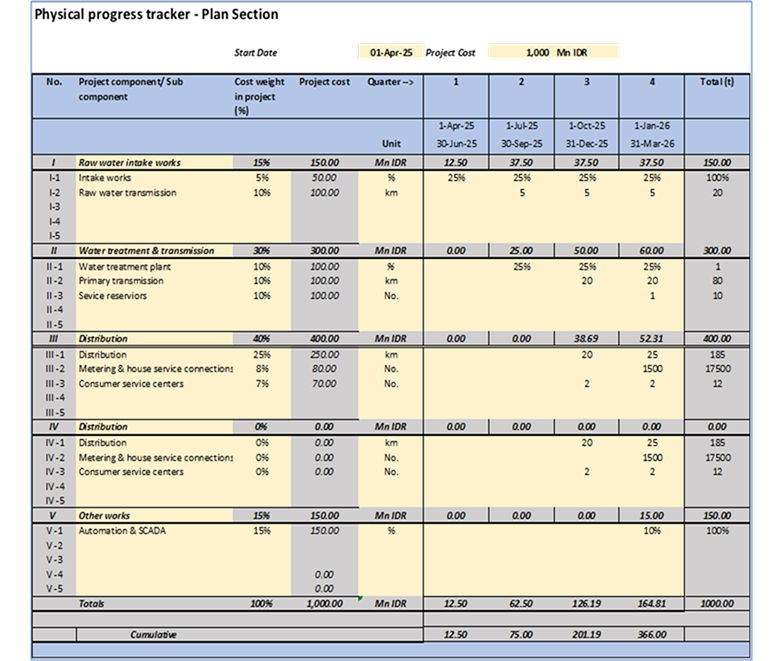
Assessing IBE’s construction plan: This includes understanding entire construction plan of the IBE. The construction plan is organized into components and sub-components by the IBE, and these components are implemented through specialized contractors or a single EPC contractor. The IE needs to assess the overall construction strategy and plan of the IBE and organise it into a physical implementation plan. A typical physical implementation plan includes the following:
-
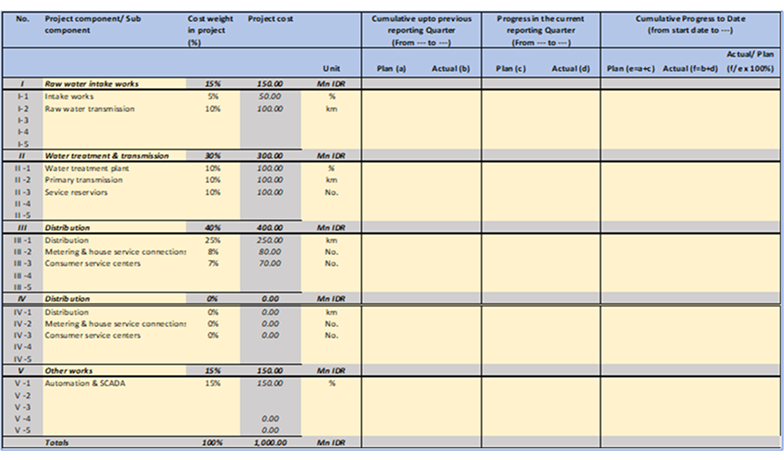
Monitoring and supervision: The IE periodically monitors the construction of the project on site and reviews the actual progress vis-à-vis the above plan. The process includes conducting regular site inspections and reviewing project implementation plans of the IBE. The IE compares the actual progress with the plan to assess the variance and conclude on the pace of construction on site. The IE project progress report may include the following table on plan v/s actual and delays, if any. The IE can also supplement the progress reporting with S-curves for plan and actuals and propose strategies and plans for scaling up construction progress in the event of delays in progress.
Tool
Physical Progress Plan v/s Actuals Monitoring Tool
-
Quality assurance: The IE monitors the quality of construction of the project to o ensure that the final product meets the required standards, specifications, and GCA expectations. The IE in consultation with the IBE and GCA will develop a quality management plan that will consist of quality assurance/ quality control procedures to be followed. The quality assurance procedures in the PPP agreement will be included in the quality management plan. This plan will include inspection and test plans, checklists, third party testing, and quality testing procedures to be applied for key project components. It will also assign roles and responsibilities across the IE team and establish reporting processes on quality testing to the Operational Management Team. The IE may use the following format to report the quality testing during a reporting period
Tests/ type conducted (nos.#) Approved without rectification Rectification recommended Rectification addressed by IBE Pending Remarks by IE Reporting quarter – from: _________ to: __________ Reporting quarter – from: _________ to: __________ Templates:
Quality Management Plan
Site Inspection Report
- Others: The IE will monitor other related aspects of the project concerning health, safety and environment standards and report on non-compliance, if any.
This activity primarily consists of contract administration activities and reporting to the Operational Management Team on periodic basis. The key activities are:
-
Obligations monitoring and tracking: To monitor construction stage, the Operational Management Team will need to have a good understanding of activities required during construction. They need to be aware of the obligations of the GCA as well as for the IBE and associated third parties. The tracking by the Team will include periodic review of obligations; updating progress; identification of issues and solving issues. The Team can deploy the following Obligations Register Template for obligations monitoring, and tracking.
Templates:
Obligation Register
Obligation Who? What? When? How? Status Example: GCA to approve detailed designs GCA: Contract Manager and IE Confirm that all detailed designs and drawings land needed for the implementation of the project has been submitted by the IBE and approved by the GCA based on IE’s review By [time/date] Liaise with []; etc. Contacted [] on [date]. [] will check status and respond by [date]. - Monthly Review and Coordination Meetings: The Operational Management Team will periodically review the construction with IBE’s counterparty team. The monthly review will include assessing construction progress, identify bottlenecks, resolve issues, and document decisions and actions. The Operational Management Team will also need to provide the IBE updates on the progress of GCA’s obligations.
-
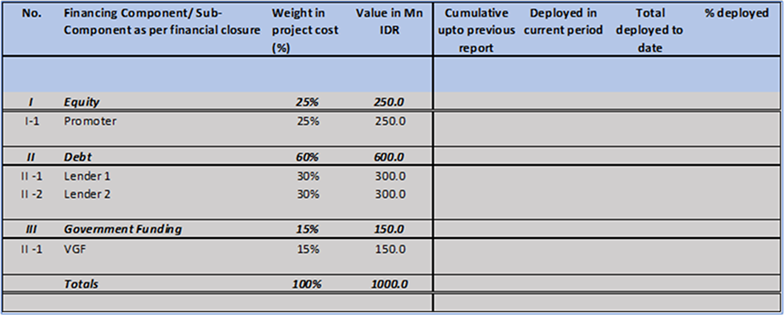
Financial monitoring: The GCA will report the deployment of finance for the project to the Operational Management Team and the IE. The financial progress of the project will be recorded in the following manner:
- Risk management: The Operational Management Team with support from the IE will monitor project risks and manage them during construction. They will also coordinate with IIGF and monitor the Key Risk Indicators highlighted by IIGF in their Risk Management Plan and report periodically.
-
Issue management and resolution: The Operational Management Team and the IE will take proactive actions to identify issues and recording it during the construction stage. This will be followed by resolving it in accordance escalation procedures and dispute management in the PPP contract and the Management of Contract Plan. The reporting by the IE will include the following issue tracker as part of its periodic reporting.
Issue description Project impact Priority Agency to resolve Action taken to date Status < describe issue > < in % or kms, area, etc. > H/ M/ L < based on criticality and project impact > < GCA/ IBE/ other related Parties (Person name, etc.) > < list actions: meeting references, completed actions, pending items > < Resolved/ Pending/ Escalated to Dispute Resolution > < Ideally tagged to a file recording a trail of discussions and documents > - Progress reporting: The IE shall prepare a quarterly progress monitoring report on the project. The progress monitoring report should include key details on construction progress, issues (if any) and facilitate the project's implementation. Refer to the template for progress reporting during construction period.
Templates:
Progress Monitoring Report
This phase of a PPP project is critical to ensure that the constructed asset meets all technical, safety, and contractual requirements before it becomes operational. The process includes the following key activities.
- Pre-commissioning testing: In PPP contracts commissioning testing is preceded by a pre-commissioning testing conducted by the IE when the project construction is substantially complete on site. This is conducted for project components and for the entire project. The IE conducts field tests and assesses the readiness of the constructed asset to be put into operations. As an outcome of the testing, the IE prepares a punch list of deficiencies observed and recommend rectification of the identified deficiencies prior to the completion of the scheduled construction completion date. This punch list is formally shared by the IE with the IBE and the GCA for action.
- Punch list rectification: The IBE undertakes actions as per the punch list and rectifies deficiencies observed by the IE during the per-commissioning tests. After completion, it will request the IE to conduct the final construction completion tests for the project.
- Commissioning testing: The IE repeats the testing for certifying construction completion and commissioning the project. It specifically checks the rectification undertaken by the IBE on the punch list items. The IE will then certify that the completion of construction after satisfying itself that all project construction requirements have been met by the IBE. The certification will be reviewed and confirmed by the Operational Management Team prior to the issue of construction completion certificate for the project.
-
Preparatory activities for service delivery: In parallel with the testing, the IBE will submit its service delivery/ operations manual to the IE for its review and finalisation of its service delivery plan. The IE will review the submissions, propose rectifications, and recommend the manual for approval by the GCA. Furthermore, the Operational Management Team will prepare the detailed stage management plan for the service delivery stage of the contract.
Checklists:
Service Delivery/ Operations Manual
The GCA will declare the completion of construction and issue the construction completion certificate for commencing commercial operations. Usually, the next day of issue of construction completion certificate is considered as commercial operations date for the project. Some PPP contracts may include procedures for replacing the construction performance securities with operations period performance securities.
The Operational Management Team thereafter archives construction related documents, prepares compliance reports and sends them to relevant authorities. The Team will also need to keep documents, minutes of meetings and other relevant documents to keep an audit trail of the activities in this stage.
The service delivery stage begins after commissioning of the asset and lasts until the end of the contract term. The transition from construction to service delivery covers the period when the infrastructure asset has been built and is ready to commence operations. Testing and commissioning are distinct activities marking the transition from construction to service operation. The service delivery stage is also called ‘Operations’ or ‘Operations and Maintenance’ stage. Specifically, service delivery begins on the Commercial Operations Date (COD) and continues till the transfer date when the infrastructure provision/asset and project is transferred back to the GCA.
Service delivery activities include
- periodic reviews including service performance reviews, controlling delays & revisions, quality assurance, managing issues & exceptions, and claims & penalties
- managing variations including articulating the need for variations, issuing notification of variations, and approvals & compensations
- Payments during service delivery including operationalising payment processes, invoicing, reviews & approvals, and documentation & release of approved payments.
Even though the IBE is contractually responsible for delivering services, the GCA as the contracting authority remains publicly accountable. The GCA’s role is to monitor the project to ensure compliance with the stated project objectives. Monitoring includes service delivery quality and user satisfaction levels through necessary consumer surveys. If service delivery fails or falls below acceptable standards, the public can hold the GCA responsible, regardless of the contractual arrangements. To that effect, governance, performance management, and risk management are crucial to service delivery.
During service delivery, the Independent Expert (IE) supports the GCA to monitor compliance to the standards specified in the PPP contract. In addition, the GCA reviews progress and performance as per pre-agreed key performance indicators (KPI). Necessary course corrections or invoking contractual terms can be undertaken if deviations from contractual terms by the IBE.
The approach consists of managing following activities listed in Management of Contract Plan. In addition to managing the activities in the Service Delivery stage, the Operational Management Team will need to prepare the contract administration plan for the Transfer stage as a key transition requirement.
- Monitor the IBE’s; environmental performance
- Monitor key performance indicators (KPIs) and manage GCA's obligations
- Collaborate with IBE, IIGF and IE to ensure regular reviews and monitoring of service delivery by the IBE
- Deepen and strengthen communications and relationships with stakeholders and public
- Manage contingencies like variations, change in law, refinancing, renegotiations, force majeure, climate change events, termination, etc.
- Monitor critical service delviery activities to ensure continuity of services in the event of environmental disasters or issues within the IBE
- Support IIGF in monitoring key project risks indicators and proactively manage issues to mitigate them
- Develop contract administration plan for the Transfer stage and manage transfer of the assets
The workflow or process for the Operational Management Team for managing service delivery activities includes the following:

Setting up a performance monitoring system during the service delivery stage is crucial for ensuring that the project meets its intended outcomes, maintains service quality, and allows for timely interventions. The key steps for setting up a performance monitoring system is as follows:
-
Defining objectives and KPIs: The output specifications and performance metrices included in the PPP contract forms the basis for defining performance objectives and KPIs. Performance objectives are overarching goals of a monitoring system and KPIs are measurable and verifiable indicators of performance. The Operational Management Team in consultations with the IE lists the objectives and KPIs after reviewing the PPP contract. In case of gaps, they can refer to the Pre-feasibility studies by the GCA and submissions made by the IBE during design stage to address gaps or refine the KPIs.
Objective of performance monitoring system include
- ensuring service quality and reliability,
- tracking operational efficiency, and
- monitoring compliance of the IBE with various output and performance related requirements in the PPP contract.
KPI is a measurable value of service delivery performance of infrastructure by the IBE. They are organised under various categories of performance along with descriptions, measurements, and frequency of measurements. Typically, KPI’s include measurable requirements with respect to availability, response time, throughput, error rates, customer satisfaction, frequency, consumption limits, etc. The table below presents sample set of KPIs for a water supply project.
SN Indicator Benchmark Target Value Measurement Data source/ Performance Monitoring 1 Coverage of water supply connections - Percentage of households with direct water connection 100% X (Number of households with direct water connections) / (Number of households services in the area) x 100 One time and periodic Consumer surveys 2 Per capita supply of water - Total water supplied into the distribution system in relation to population served per day 135 lpcd X (Water supplied to distribution network per day) / (Population served) Actual water supplied measured from output flow meter at the water production unit 3 Extent of metering of water connections - Operational efficiency of total water connections 100% X (Total Number of functional metered connections) / (Number of connections) x 100 Regular checks on functionality of metered connections Data maintained by private operator 4 Extent of Non-Revenue Water - Difference between the total water produced and total water sold 15% X [(Total Water Produced) – (Total Water Sold)] / [Total water produced] x 100 Readings from Service Reservoir outlets Log of consumer meter readings 5 Continuity of water supply - Average number of hours of pressurized water 24 X 7 X (Daily hours of supply over a continuous period of 7 days) / 7 Data log maintained by Private operator at zonal & distribution levels 6 Efficiency in redressal of customer complaints - Number of complaints redressed within 24 hours of receipt 80% X (Number of complaints redressed within 24 hours) / (Total Number of complaints received in a month) x 100 Log of customer complaints Customer endorsements of complaints redressed 7 Quality of water supplied - Supply of water based on specified quality standards 100% X (Number of samples that meet quality standards) / (Total number of samples tested) x 100 Samples tested at water treatment plant, distribution network and consumer end 8 Cost recovery in water supply services - Efficiency is water supply 100% X (Total operating revenue) / (Total operating expenses) x 100 Financial statements of pvt operator pertaining to project 9 Efficiency in collection of water supply charges Efficiency in operations 90% X (Total current year revenue collected) / (Total current year billed) x 100 Financial statements of pvt operator pertaining to project PPP contracts include targets for the IBE during the contract period. The targets are usually structured on a gradual improvement scale of service delivery to achieve the output specifications for a project. The conversion of the above sample KPIs for water supply project into annual measurable targets are:
SN Performance Indicator Benchmark Status Targets Year 1 Year 2 Year 3 Year 4 Year 5 1 Coverage 100% 45% 50% 60% 70% 85% 100% 2 Per Capita Supply of Water 135LPCD 75 80 90 100 120 135 3 Extent of Metering 100% 0% 50% 80% 100% 100% 100% 4 Extent of NRW 15% 34% 30% 25% 20% 15% 15% 5 Continuity of water supply 24x7 1 hour 5 10 15 20 24 6 Efficiency in redressal of customer complaints 80% 73.3% 75% 80% 80% 85% 85% 7 Quality of Water Supplied 100% 100% 100% 100% 100% 100% 100% 8 Cost Recovery 100% 49.1% 50% 60% 70% 85% 100% 9 Efficiency in Collection of Water Charges 90% 50.8% 65% 75% 85% 90% 90% -
Choosing monitoring tools and techniques: The Operational Management Team will select suitable KPI monitoring tools to collect information to measure the service delivery performance of the IBE. These tools include
- Physical tools – flow meters, weighing machines, energy meters, laboratory tests, etc;
- Reports and records – financial statements, operations logs, customer grievance logs, user feedback logs, etc;
- IT based systems - IoT Sensors for real-time data (temperature, vibration, usage), SCADA Systems, Network Monitoring Tools (e.g., Nagios, Zabbix), Cloud Monitoring Platforms (e.g., AWS CloudWatch, Azure Monitor), GIS Systems for spatial performance tracking, etc;
- Sampling – spot checks, customer surveys, random sampling statistical testing methods, etc;
- Visual – manual inspections, site surveys, etc.
-
Design data collection and analytics framework: The data collection framework flows from the chosen monitoring tool and technique and contract measurement requirements. The frequency of data collection could include - real-time for critical systems, daily/weekly for routine metrics, monthly/quarterly for strategic reviews, etc. Data collected is analysed using business intelligence tools for data analytics (e.g., Power BI, Tableau, etc.), which is then fed into visualisation tools like dashboards and periodic reports.
- Physical tools – flow meters, weighing machines, energy meters, laboratory tests, etc;
- Reports and records – financial statements, operations logs, customer grievance logs, user feedback logs, etc;
- IT based systems - IoT Sensors for real-time data (temperature, vibration, usage), SCADA Systems, Network Monitoring Tools (e.g., Nagios, Zabbix), Cloud Monitoring Platforms (e.g., AWS CloudWatch, Azure Monitor), GIS Systems for spatial performance tracking, etc;
- Sampling – spot checks, customer surveys, random sampling statistical testing methods, etc;
- Visual – manual inspections, site surveys, etc.
The column on Date Source and Performance monitoring the above table is an example of monitoring tools and techniques for measuring performance.
This includes monitoring performance of the IBE vis-à-vis the performance indicators. The performance monitoring procedure is described in a PPP contract. One of the following performance monitoring procedures is normally included in a PPP contract. This monitoring system closely ties in with the PPP contract payments and incentive systems.
- Trigger based monitoring: project performance and/ or event of default by IBE is evaluated based on total amount of deductions or liquidated damages accumulated beyond the threshold amount defined in the PPP contract during a performance monitoring period.
- Point based trigger: wherein project performance and/ or event of default by IBE is evaluated based on Performance Default Points (PDP) accumulated beyond the threshold defined in project agreement for a performance monitoring period.
The defaults or non-performance is assessed based on:
- Events: wherein project non-performance by IBE is counted based on number of failures on a regular KPI and/or a critical KPI failure; and/ or
- General penalty levied: wherein default by IBE on a KPI is tagged to a financial penalty value.
Service delivery oversight by IBE also includes conducting regular audits and inspections, regular review meetings and managing complaints and feedback from users. The following table is an example of conversion of non-performance on KPIs to penalties.
| SN | Performance Indicator | Penalties |
|---|---|---|
| 1 | Coverage |
Between 99%-90% of target – IDR “x1” per % of shortfall
Between 90% to 80% of target – IDR “y1” per % of shortfall Below 80% of target – IDR “z1” per % of shortfall |
| 2 | Per Capita Supply of Water |
Between 90%-80% of target – IDR “x2” per capita of shortfall
Between 80% to 60% of target – IDR “y2” per capita of shortfall Below 60% of target – IDR “z2” per capita of shortfall |
| 3 | Extent of Metering |
Between 99%-90% of target – IDR “x3” per % of shortfall
Between 90% to 80% of target – IDR “y3” per % of shortfall Below 80% of target – IDR “z3” per % of shortfall |
| 4 | Extent of Non-revenue Water |
Between 80%-70% of target – IDR “x4” per capita of shortfall
Between 70% to 50% of target – IDR “y4” per capita of shortfall Below 50% of target – IDR “z4” per capita of shortfall |
| 5 | Continuity of water supply |
Between 90%-80% of target – IDR “x5” per hour of shortfall
Between 80% to 60% of target – IDR “y5” per hour of shortfall Below 60% of target – IDR “z5” per hour of shortfall |
| 6 | Efficiency in redressal of customer complaints | Below 90% of target – IDR “x6” per hour of delay |
| 7 | Quality of Water Supplied |
Between 90%-80% of target – IDR “x7” per hour of shortfall
Between 80% to 50% of target – IDR “y7” per hour of shortfall Below 50% of target – IDR “z7” per hour of shortfall |
| 8 | Cost Recovery |
Between 90%-80% of target – IDR “x8” per % of shortfall
Between 80% to 60% of target – IDR “y8” per % of shortfall Below 60% of target – IDR “z8” per % of shortfall |
| 9 | Efficiency in Collection of Water Charges |
Between 90%-80% of target – IDR “x1” per % of shortfall
Between 80% to 60% of target – IDR “y1” per % of shortfall Below 60% of target – IDR “z1” per % of shortfall |
The activities under payments and incentive management depend on the revenue mechanism in a PPP contract. In the case of an availability payment (AP) project the revenue mechanism includes periodic payment of APs during the service delivery period. AP payments are usually structured in three parts comprising
- fixed payment,
- adjustments to the fixed payments, and
- deductions/ compensations/ incentives.
The payment mechanism for an availability payment project would include procedures and timing for submission of invoices by the IBE and release of payment by GCA. Delays in release of payments result into triggering of default by the GCA and the IIGF (if the project is guaranteed) stepping in and releasing the payment on behalf of the GCA. The procedure for payment includes the following:
- Submission of invoices by the IBE as per agreed format with payment information on the invoice due date;
-
This invoice is reviewed by the IE for its accuracy with respect to the PPP contract and recommending the GCA to release payment. The IE review would be timebound and will include the following.
- Review of fixed payment amount as per PPP contract requirements;
- Review of adjustments to fixed payments. PPP contracts include adjustments for change in macro-economic parameters like changes in foreign exchange rate, inflation, interest rate, additional service delivered, etc. depending on the risks sharing arrangements, baselines, and sources for the rates in the PPP contract;
- Recommend deductions based on the IBE’s performance on KPIs and the penalty mechanism in the PPP contract. Some contracts may also include incentives for performance delivered beyond the required thresholds. These adjustments will also be recommended.
- The IE reviewed invoice will be shared with the Operational Management Team for release of payments. A copy of the reviewed invoice is also shared with the IBE for information;
- Operational Management Team will review the recommendations by the IE and recommend release of the payment to the finance and accounts team in the GCA as per its review.
- The GCA will release payment to the IBE on the scheduled payment date
- In case the IBE does not agree with the IE’s review, it can seek review under the provisions of issue management, escalation procedure, and dispute resolution in the PPP contract.
In the case of user charge-based projects, the IE will periodically recommend penalties to be levied on the IBE for KPI non-performance. The Operational Management Team will raise a claim on the IBE for payment of penalties. This claim is normally deducted from the Escrow account of the project. The GCA also reserves the right to deduct the penalty from the performance security of the IBE.
This activity primarily consists of contract administration activities and reporting to the Operational Management Team on periodic basis. The key activities are:
-
Obligations monitoring and tracking: To monitor service delivery stage, the Operational Management Team will need to have a good understanding of activities required during construction. They need to be aware of the obligations of the GCA as well as for the IBE and associated third parties. The tracking by the Team will include periodic review of obligations; updating progress; identification of issues and solving issues. The Team can deploy the following Obligations Register Template for obligations monitoring, and tracking.
Templates:
Obligation Register
Obligation Who? What? When? How? Status Example: GCA to approve operations manual GCA: Contract Manager and IE Confirm that all procedures and activities needed for delivery of service as per KPIs has been detailed and included in the operations manual submitted by the IBE and approved by the GCA based on IE’s review By [time/date] Liaise with []; etc. Contacted [] on [date]. [] will check status and respond by [date]. - Monthly Review and Coordination Meetings: The Operational Management Team will periodically review the service delivery with IBE’s counterparty team. The monthly review will include assessing performance with respect to KPIs, process improvements, identify bottlenecks, resolve issues, and document decisions and actions. The Operational Management Team will also need to provide the IBE updates on the progress of GCA’s obligations.
- Financial monitoring: The IBE will submit its audited annual financial reports the GCA for records.
- Risk management: The Operational Management Team with support from the IE will monitor project risks and manage them during service delivery. They will also coordinate with IIGF and monitor the Key Risk Indicators highlighted by IIGF in their Risk Management Plan and report periodically.
-
Issue management and resolution: The Operational Management Team and the IE will take proactive actions to identify issues and recording it during the service delivery stage. This will be followed by resolving it in accordance escalation procedures and dispute management in the PPP contract and the Management of Contract Plan. The reporting by the IE will include the following issue tracker as part of its periodic reporting.
Issue description Project impact Priority Agency to resolve Action taken to date Status < describe issue > < in % or kms, area, etc. > H/ M/ L < based on criticality and project impact > < GCA/ IBE/ other related Parties (Person name, etc.) > < list actions: meeting references, completed actions, pending items > < Resolved/ Pending/ Escalated to Dispute Resolution > < Ideally tagged to a file recording a trail of discussions and documents > - Progress reporting: The IE shall prepare a quarterly performance monitoring report on the project. The performance monitoring report should include key details on performance on the KPIs, progress, issues (if any) and facilitate the project's service delivery. Refer to the template for performance monitoring report during service delivery period.
Templates:
Performance Monitoring Report During Service Delivery
The GCA will engage with external stakeholders to assess public feedback on the delivery of service. The engagement may include
- communication with the public about service quality and improvements;
- engagement with local communities and specific stakeholders (such as project-affected parties, persons with disabilities (Persons with Disabilities) and/or specific social or disadvantaged groups, etc.) and users for their feedback;
- reporting to government agencies, oversight agencies and sector regulators.
The project will need to institutionalise public grievance redressal systems to ensure that the public and stakeholders can provide their feedback on the project. The system needs to include the following features for recording and redressing complaints:
- Easy access and provision of multiple channels to stakeholders to lodge their complaints (e.g., QR based online systems, emails, WhatsApp bot-based templates, telephone based, emails, complaint box, complaint desk, etc);
- Documentation of intake of complaints and grievances with unique IDs, time stamps, and issue categorisation;
- Each complaint will be analysed and responded based on type of issue, stakeholder engagement, and need for providing tailored solutions;
- Timely resolution of complaints and analytics on the complaint types to address systemic issues; and
-
Escalation of unresolved complaints in line with the issue management and resolution procedures.
The public grievance redressal systems can be setup as offline and online platforms with appropriate institutional set-ups for monitoring performance. The system at the minimum needs to include designated grievance officers, integration with the management of contract governance systems and monitoring through periodic reports. The system may also involve specialist NGOs for trust building and monitoring sensitive issues with local communities, gender, people with disabilities, specific social or disadvantaged groups, etc.
Templates:
Public Grievance Redressal Systems
Continuous improvement is a strategic approach that enables GCAs and IBEs to enhance service quality, operational efficiency, and stakeholder satisfaction throughout the lifecycle of the project. It is aimed at:
- ensuring consistent delivery of agreed service levels,
- identification and elimination of inefficiencies or bottlenecks,
- responding proactively to stakeholder feedback,
- adapting to changing regulatory, environmental, or technological conditions, and
- strengthening public trust and accountability.
Continuous improvement is a collaborative exercise where the Operational management team and the IBE analyses time series data on KPI performance, long term service delivery goals, user satisfaction levels, etc. It involves undertaking root cause analysis and introducing corrective actions to address issues. The corrective actions could include improved operational measures, technological solutions/ upgrades, innovation, training, and capacity building of operations staff for improved service orientation, etc.
Mid-term reviews are structured processes undertaken by GCAs to ensure continued alignment of the infrastructure service with evolving public needs. It is conducted at the midpoint of the service delivery phase to
- assess project performance against contractual obligations,
- identify risks, bottlenecks, and improvement opportunities,
- ensure alignment with public service objectives, and
- recommend corrective actions or renegotiations if necessary.
Many PPP contracts include provisions for undertaking mid-term reviews, sharing of risks and costs for upgrades, and implementation of upgrades and solutions. Usually, requirement of substantial upgrades and changes from the mid-term review may require renegotiation of the terms of PPP contract and implementing them can be time-consuming. Refer to the template for procedures on undertaking mid-term review of PPP projects.
Templates:
Mid-Term Review Procedure
The transfer stage is started towards the end of the PPP contract term. It covers procedures and activities to hand back or exit or transfer of a project asset/infrastructure provision i.e., transfer the responsibility for infrastructure assets to the GCA upon the termination or expiry of the PPP contract. This stage typically begins in the last two or three years of the PPP contract and runs in parallel with service delivery. The management of the contract team continues to manage the project's service delivery and transfer activities till the end of the PPP contract.
The transfer stage is part of the service delivery stage, and it runs in parallel towards the end of the PPP contract. It covers procedures and activities to hand back or exit or transfer of a project asset/infrastructure provision i.e., transfer the responsibility for infrastructure assets to the GCA upon the termination or expiry of the PPP contract.
This stage involves the asset or the service delivery (operations) of the asset to be ‘handed back’ or transferred to the GCA. This transition is important as it affects the ongoing provision of public service. During this stage, the IBE complies with contractually stipulated hand back requirements that describe the asset condition as expected and to be demonstrated at the end of the contract term. The required asset condition is described by measurable technical standards, so that they can be verified independently.
At the transfer stage, the GCA ensures that the IBE has performed its obligations as per contractual terms, all assets relating to the project have been created and all assets are in condition as detailed in the contract. The GCA also ensures that the necessary remedial action, if any, that may have been required by the IE have all been undertaken by the IBE.
In addition, the GCA ensures that all assets are transferred back into the control of the GCA. These assets could include physical assets and human resources which may be on deputation to the IBE during the contract. Prior to the contract expiry date, the GCA puts a team in place to take over project operations to ensure continuity of service. This team formally takes over operations on the date of the transfer. A transfer is demonstrated when the GCA issues a vesting certificate to the IBE to formally recognise such transfer.
The approach consists of managing the following activities listed in Management of Contract Plan.
- Monitor IBE's compliance with obligations on handover
- Manage strategic relationships with stakeholders at expiry
- Manage smooth asset transfer from IBE to GCA while maintaining service delivery
- Managing resources, knowledge and service delviery
- Managing pending issues with stakeholders
- Obtain performance securities from the IBE for the defects liability period after asset handover
- Deploy GCA team, provide training to GCA staff or new operator to manage the project assets and deliver service
- Ensure that the transfer of knowledge and technical expertise is carried out throughly
The workflow or process for the Operational Management Team for managing Transfer includes the following:

Preparation for transfer of an infrastructure asset typically begins in the last two or three years of the PPP contract. The IE or the GCA commences the process with detailed inspections to assess the asset condition against hand-back standards. The preparation includes the following steps:
- Conducting detailed asset inspections, assessing useful life and continued performance of the asset after transfer;
- Assessing the asset vis-à-vis the expected or contracted asset condition standards at transfer;
- Identifying deficiencies and preparing a punch list of deficiencies and rectifications to be done by the IBE to bring the assets as per required standards;
- Submission of asset hand-over rectification performance security based on the estimated value of rectification observed during inspection;
- Conducting follow-up inspection every six months to check for rectification of deficiencies noted in the previous inspection;
- Preparing detailed transfer plan including timelines, responsibilities, and documentation requirements;
- Ensuring all obligations under the PPP contract are fulfilled
Templates
Asset Hand-Over Plan
The final transfer of the asset will be completed at the end of the term of the PPP contract. However, the last six months consists of many activities to ensure hand-back proceeds as planned. Ideally, the Operational Management Team should prepare obligations register to track all activities to be tracked for transfer.
Templates
Obligation Register
| Obligation | Who? | What? | When? | How? | Status |
|---|---|---|---|---|---|
| Example: IBE to provide spares and operations related inventory for the project | GCA: Contract Manager | Confirm that all spares and inventory for continuing operations after handover has been accounted for and transferred. | By [time/date] | Liaise with IBE: Site Manager | Contacted [] on [date]. [] will check status and respond by [date]. |
About one month prior to the transfer the Operational Management Team will need to initiate a final transfer assessment. The Team will also need to do a detailed compliance check to verify that the assets meet the required performance and maintenance standards. The Team can deploy the IE and/ or independent third parties to undertake these activities. The IBE will need to address any deficiencies observed. The GCA also reserves the right to deduct the cost of rectification from the asset handover rectification security in case the IBE does not undertake the rectifications. The steps 03 to 07 detail the activities during Transfer.
Checklists
Asset Condition Assessment
This activity includes transfer of documentation on operations, maintenance, and performance to the GCA. The documents include:
- O&M Manuals: Updated and complete manuals handed over.
- Maintenance Records: Full history of maintenance and repairs.
- Asset Inventory: Final list of all assets with specifications and warranties.
- Environmental and Safety Records: Compliance documentation.
This is a key activity that ensures smooth transfer of service delivery from the IBE to GCA, it includes:
- Staff Training: GCA personnel trained on operations, systems, and maintenance.
- System Handover: Transfer of IT systems, software licenses, and access credentials.
The key activities to effect transfer includes the following:
- Final Payments: Settlement of any outstanding payments or penalties.
- Termination Certificates: Issuance of formal handover certificates.
- Release of Guarantees: Return of performance bonds or guarantees.
- Collection of defects liability guarantee: IBE will provide a performance bond or guarantee for the defects liability period as per the PPP contract requirement
The formal handover is done on the last day of the PPP contract. However, the activity it begins about 3 – 5 days before the formal handover. The official transfer of asset and risks from the IBE to the GCA is considered from 12:00 am of the next day of the expiry of the PPP term. The activities include:
- Joint Inspection: Final inspection by both parties.
- Handover Ceremony: Formal event marking the transfer.
- GCA Assumes Control: The GCA or its designated takes over service delivery of the asset.
The following is a list of key documents for the transfer:
- Handover Plan
- Final Asset Condition Report
- Updated O&M Manual
- Training Records
- Legal Closure Documents
- Handover or vesting Certificate
Thereafter, the GCA issues a formal notification to stakeholders (lenders, insurance companies, local governments, project affected persons, police, associated departments of the Government, etc.), to notify the transfer of asset to the Government/ GCA.
The Operational Management Team will need to prepare compliance reports and send them to relevant authorities. The Team will also keep documents, minutes of meetings and other relevant documents to keep an audit trail of the activities in this stage.
The transfer stage is part of the service delivery stage, and it runs in parallel towards the end of the PPP contract. It covers procedures and activities to hand back or exit or transfer of a project asset/infrastructure provision i.e., transfer the responsibility for infrastructure assets to the GCA upon the termination or expiry of the PPP contract.
This stage involves the asset or the service delivery (operations) of the asset to be ‘handed back’ or transferred to the GCA. This transition is important as it affects the ongoing provision of public service. During this stage, the IBE complies with contractually stipulated hand back requirements that describe the asset condition as expected and to be demonstrated at the end of the contract term. The required asset condition is described by measurable technical standards, so that they can be verified independently.
At the transfer stage, the GCA ensures that the IBE has performed its obligations as per contractual terms, all assets relating to the project have been created and all assets are in condition as detailed in the contract. The GCA also ensures that the necessary remedial action, if any, that may have been required by the IE have all been undertaken by the IBE.
In addition, the GCA ensures that all assets are transferred back into the control of the GCA. These assets could include physical assets and human resources which may be on deputation to the IBE during the contract. Prior to the contract expiry date, the GCA puts a team in place to take over project operations to ensure continuity of service. This team formally takes over operations on the date of the transfer. A transfer is demonstrated when the GCA issues a vesting certificate to the IBE to formally recognise such transfer.
-
Renegotiation of a PPP contract implies a change to the original contract terms and conditions. This is distinct from variation. A variation is a minor scope change or simple correction of errors or clarification on contract. Renegotiation occurs when the original contract and financial impact of a PPP contract is significantly altered, and such changes are not the result of defined and detailed procedures spelled out in the contract. Defined procedures could be, for example on performance, scope of work variation, risk allocation etc. When defined processes do not include other changes (due to contracts being exposed to external changes arising from political, social, and economic circumstances) during the contract, it leads to renegotiation between the GCA and the IBE. Renegotiation is a significant event in a PPP contract. It can have a major impact on the project’s success or failure and can demand significant resources and time from the GCA to implement. Renegotiation centers on the allocation of risk. The GCA is responsible for introducing policies to limit frequent renegotiations and to fully assess the appropriateness of renegotiation. During renegotiation, the GCA considers its transparency and ensures good record keeping practices. Alternatively, the GCA can consider termination over renegotiation.
Regulations in Indonesia stipulates guideline on renegotiations (which is referred as “amendment of PPP agreement”). Article 53 Bappenas Regulation No. 7/2023 stipulates that an amendment of a PPP Agreement may be carried out based on mutual agreement between the GCA and the IBE, subject to the following conditions:
- it shall not alter the project structure;
- it shall not affect the financial feasibility of the project;
- it shall not change the agreed risk allocation;
- it shall not amend the previously determined bid parameters;
- it shall not reduce the service level;
- and it shall not increase the GCA or government’s obligations under the PPP agreement.
Nevertheless, the Parties may still amend the restricted matters set out above, if they can establish that:
-
The following criteria are satisfied:
- The amendment is made to ensure the continuity of the Project;
- The amendment has a positive impact or is intended to maintain the Value for Money (VfM); and
- The amendment is based on the same baseline Internal Rate of Return (IRR) assumption; and/or
- The amendment is necessary to implement government policy.
-
Renegotiation is one of the potential risks in PPP project implementation as part of risk mitigation. Best practices are suggested including clear renegotiation mechanisms within the PPP agreement, such as modification clauses and dispute resolution procedures. It is essential to define the steps, timeline, and responsible parties to ensure transparency and efficiency throughout the process. The following are the commonly observed stages of renegotiation in PPPs:
Initiation: Renegotiation may be initiated by either the GCA or the IBE. The initiating party must submit a formal written notification stating the reasons and justification for the renegotiation. Upon receiving the notice (or, if prepared by the GCA, then prior to submission to the IBE), GCA should conduct a preliminary assessment to evaluate the potential impact and whether the request aligns with provisions of the PPP agreement. This includes checking if the proposed negotiated clause relates to restricted matters that may require further regulatory consideration.
Preparation: Following notification, both parties prepare for renegotiation by reviewing the PPP contract and relevant supporting documents. This stage is ideally conducted within a defined time as specified in the contract to ensure discipline in the process. Parties should also determine whether third-party stakeholders (such as Bappenas, LKPP, or the Ministry of Home Affairs) need to be consulted or notified. Legal, financial, and technical advisors may also be engaged to assess the implications of the renegotiation proposal.
Negotiation: Formal negotiation is carried out between the GCA and the IBE, often with the support of experts or consultants relevant to the subject matter. Discussions should aim at reaching consensus on amended terms, with outcomes documented clearly in a draft amendment. If the renegotiation involves restricted matters, consultations with relevant authorities (e.g., Bappenas or other line ministries) should be undertaken prior to finalizing the terms. Projects that receive government guarantees typically also require notification from, and approval from, the guarantor before signing any amendment. Transparency and record-keeping throughout this process are critical.
Implementation: Once agreement is reached, the amendment to the PPP contract is executed by both parties. The GCA must ensure that all affected stakeholders are informed, including Lenders and, if applicable, IIGF. The agreed changes should be reflected in updated monitoring frameworks and project documentation. If the GCA maintains monitoring tools, the changes resulting from the amended agreement should be reflected and updated accordingly in those tools.
-
Refinancing refers to changing or replacing the existing lenders or terms on which debt obligations have been agreed between the IBE and its lenders. The IBE would have typically raised debt capital (such as bank loans, bonds etc.) for the project and would have equity of its shareholders as well. Where the IBE has taken the risk on the debt financing, it is entitled to rearrange it, though this is often subject to restrictions. Refinancing may include any or a combination of
- type or source of debt (e.g., shifting from bank loans to bonds or different sources of financing)
- loan amount
- change in interest margin or debt pricing
- change in loan duration/debt maturity (tenor)
- payment or repayment terms
- hedging arrangements (e.g., to manage interest rate risk)
- change in amount of debt relative to equity (gearing ratio)
- a change in the security arrangements (e.g., share charges, project asset security etc.)
- change in repayment terms (including when capital is required to be repaid)
- change in lenders or debt providers
- change in other finance terms (e.g. loan covenants) and
- change in reserve account requirements (e.g., debt service reserve account)
Refinancing is important to the GCA if the PPP contract has a provision that any financial gains resulting from a refinancing will be shared with the GCA. In general, refinancing can shift the risk profile initially agreed upon between the GCA and the IBE, hence GCA approval may be required before proceeding with refinancing.
Several common mechanisms are typically embedded in the PPP agreement to manage refinancing activities:
- Prior written notification to the GCA is usually required in advance of the proposed refinancing. This arrangement was meant to provide sufficient time for the GCA to review and engage in discussions or negotiations if needed.
- The financial gains from refinancing may be subject to claw back by the GCA.
- The IBE is generally required to notify and provide the GCA with relevant information and drafts of the refinancing documents, prior to therefinancing being finalized.
Managing Refinancing
-
While refinancing may be initiated by the IBE to optimize debt terms, the GCA must ensure that such actions do not adversely affect the project's risk allocation or financial balance. To support sound management practices, the PPP agreement typically sets out procedures to manage refinancing, including notification, review, potential approvals, and gain-sharing arrangements.
Initiation: Refinancing is typically initiated by the IBE, who identifies an opportunity to improve the terms, structure, or source of its project debt. Before proceeding, the IBE must formally notify the GCA in writing, outlining the refinancing proposal, rationale, and expected timeline. The IBE may also be required to provide supporting documentation, such as an updated financial model and detailed calculation of the refinancing impact. This early notice allows the GCA to assess potential consequences, including any gain-sharing entitlement, risk profile shifts, or contract compliance issues.
Review and Approval: Upon receiving the notification, the GCA will review the refinancing documents, particularly assessing whether any financial gain is expected. If the refinancing would generate financial gains, the GCA will assess whether the gain-sharing mechanism (e.g., claw back formula) in the PPP contract is triggered and calculate the entitled amount. The parties may enter discussions to finalize gainsharing and ensure compliance with the PPP agreement. PPP agreement may require IBE to obtain GCA approval. Once approved, IBE can proceed with the refinancing process with the lender. If the refinancing results in amendments to key terms of the PPP agreement, such changes must be formalized through an amendment.
Documentation: After execution of the refinancing agreements, the IBE is required to submit a copy of the finalized documents to the GCA for record-keeping and audit purposes.
-
Variations in PPP contractual terms are inevitable especially due to their long tenors and can occur in any stage of the management of contract. The nature of such changes could either be trivial with little or no impact on project variables and on the GCA or the IBE or changes could have significant impact on both parties. Changes could be of any nature, for example: amendments in the rights or obligations of either party, or adjustments in project timelines or compensation structures etc. Change events call for effective management, regardless of whether they are anticipated or not. Variation management is one of the key areas of the contract administration function and needs to be a collaborative process between the GCA and the IBE. Variation management aims to ensure that a planned and coordinated approach is applied to deal with the changes impacting the project; to maintain original risk allocation unless redistributing risks is found to be beneficial for the GCA and the stakeholders, especially the community; and to retain or improve the originally projected VfM outcomes for the project. Day-to-day operational variation issues which have no material impact on the project variables are managed by the IBE. Any day-to-day variation which is likely to have a material impact on project variables such as project cost and delivery schedules are promptly notified to the management of contract team and steps taken accordingly to manage them.
Both Presidential Regulation No. 38/2015 and Bappenas Regulation No. 7/2023 stipulate that contract variation for the works or services (commonly referred to as “modifications”) constitute one of the minimum components to be agreed upon in a PPP Agreement. This ensures that the parties have a shared understanding and agreed provisions at the outset regarding the mechanism for contract variations/modifications. The regulations, however, do not provide specific guidelines on the implementation of such modifications. Both parties may propose modifications to PPP Agreements. If the modification request is initiated by the GCA, the IBE shall submit a modification proposal setting out the analysis and implementation costs, the proposed modification, and its potential impacts. If initiated by the IBE, the IBE can prepare and request for GCA’s approval.
All modifications shall be designed, constructed, and tested in accordance with the drawings and technical specifications of the modification, good industry practice, applicable laws and standards, the requirements of the relevant authorities, the terms of the modification approval, and the environmental documentation. Further, the modifications shall be designed and constructed so that any works and facilities may continue to achieve their intended purposes, are carried out with minimal disruption to the service provision by the IBE, and are completed and tested in accordance with the technical completion criteria and trial acceptance criteria as set out in the modification approval.
Managing Contract Variation
-
As previously explained, contract modifications (variations) are among the minimum components that must be addressed in a PPP Agreement. Therefore, the parties should refer to the specific provisions in the agreement when managing such changes. In general, the following steps outline how variations are typically managed:
Initiation: Modifications may be proposed by the GCA or the IBE during the project period. Proposals must include a clear description of the proposed modification, estimated changes to project costs, and the expected impact on implementation schedule, service delivery, and KPI achievements. If the modification is proposed by GCA, the GCA shall notify the IBE, and the IBE shall follow up by preparing and submitting a formal modification proposal containing the required analysis and documentation. If the modification is initiated by IBE, IBE can submit the proposal directly to GCA for review and approval.
Preparation: During this phase, the party submitting the proposal compiles all supporting information, including technical specifications, cost estimates, analysis of impacts, and implementation plans. GCA may also require IBE to demonstrate how the modification reflects market pricing and maintains KPI commitments. If GCA deems the proposal does not reflect competitive pricing, IBE may be instructed to carry out a competitive tender process involving at least three qualified contractors. The preparation phase also includes coordination between GCA and IBE to align expectations, discuss key risks, and determine potential compensation mechanisms.
Review and Decision: Upon receipt of a complete proposal, GCA evaluates the proposed modification. The GCA may:
- reject the proposal,
- approve it (conditionally or unconditionally), or
- request further information or clarification.
GCA is not obligated to approve a modification, and IBE acknowledges that no compensation will be provided for any increase in project cost due to modifications unless explicitly agreed.
Implementation: Once approved, the IBE must implement the modification in accordance with the approved drawings and technical specifications, good industry practice, applicable laws and environmental standards, and the conditions stated in the modification approval. Modifications should be carried out with minimal disruption to existing services and ensure that the facilities remain fit for purpose. No works may commence prior to formal approval by the GCA. In addition, any modification that alters the rights or obligations of the parties must be formalized through an amendment to the PPP Agreement, in accordance with the applicable provisions.
Documentation and Update: After completion of the modification works, IBE must submit updated documentation to GCA, including two copies of the as-built drawings and any changes to the Detailed Engineering Design.
-
-
A change in law or a sanction can impact the IBE because it must adhere to the rules and regulations of the jurisdiction in which it operates and is associated with for the project. Which party is required to pay any additional costs related to a change in law depends on the risk allocation agreed upon in the PPP contract. The PPP contract may set out the conditions under which a party can seek relief due to specific changes in law, and it may also state which changes in law will not carry any entitlement to relief. In international practice, an important distinction is made between
- general changes in law (which apply to all businesses),
- specific changes in law (which apply only to a certain sector or category of activities), and
- discriminatory changes in law (which apply only to the project or a particular entity).
Compensation is usually only provided for discrimination or, in some cases, specific changes in law, while general changes in law are typically not compensable. The types of changes in law that are usually eligible for compensation include: discriminatory changes in law; specific changes in law (for example, regulations on PPP sector or the relevant infrastructure sector); changes in law prohibiting foreign investment or the repatriation of capital/funds abroad; and other particular forms of changes in law that may specifically pose a risk to the relevant sector. Changes in law due to policy, law or regulation may materially change the IBE’s ability to meet its contractual requirements, and it will typically expect to be compensated. Such a change can be implemented through various mechanisms in a PPP contract such as a change in law claim or financial rebalancing, which can be managed through Independent Experts. On the other hand, there may be potential for the IBE to benefit from a change in law, i.e., compensation payments for change in law can flow in either direction.
Existing regulations do not provide specific provisions regarding change in law.
It is common practice to limit compensation for changes in law to only specific and discriminatory changes. Compensation may also only be granted once a certain monetary threshold (cap) has been exceeded.
PII (Indonesia Infrastructure Guarantee Fund) identifies this as a public sector risk. Mediation or negotiation prevails as mitigation for change in law, and the risk may be covered through government guarantees.
Managing Change in Law
-
Change in law is one of the key risks that must be anticipated and mitigated early in the project lifecycle. Managing change in law follows the same procedural steps as renegotiation, but due to its legal and regulatory nature, it requires more technical expertise during implementation. Further, the first and most effective mitigation step is proper drafting of the PPP agreement.
Drafting Stage: The PPP agreement should clearly define all terms related to change in law, including:
- The scope of "applicable law", which may include not only laws but also regulations, decrees, and administrative rulings.
- Distinction between “general changes in law” and “qualifying changes in law” (i.e., specific, or discriminatory changes).
What constitutes “discriminatory change in law” and “specific change in law.”
Initiation: The party that becomes aware (or ought to be aware) of a change in law must notify the other party in writing, including an initial assessment of its potential impact. Upon receipt of notification, both parties arrange to jointly assess the situation.
Discussion: The IBE must provide adequate documentation, showing:
- The legal basis for claiming that the change qualifies as a compensable change in law under the PPP agreement (i.e., that it is discriminatory or specific in nature, not general).
- Causality, showing that the change in law has a direct and material adverse effect on IBE’s ability to perform its obligations or maintain the financial viability of the project (this may be supported by an adjusted financial model), along with a proposed form of compensation.
- Efforts to mitigate, by showing that the IBE has taken reasonable steps to minimize the impact of the change (e.g., cost reduction, process adjustment, alternative compliance methods).
The GCA will assess the submission and may seek review from relevant oversight bodies such as BPKP.
Negotiation and Agreement: Once a law change is identified, both parties enter negotiations to assess if the change qualifies under the contract as compensable (typically if it is discriminatory or specific). Experts should be involved to determine the scope and financial impact. Since this risk typically falls on the GCA, the GCA must ensure that any relief or adjustment provided to the IBE is justified, proportionate, and maintains value for money. If compensation is warranted, the parties must agree on the adjustment mechanism, such as cost reimbursement, tariff increase, or contract term extension. This agreement is formalized through an amendment to the PPP Agreement and other impacted documents.
Implementation and Closure: The GCA ensures internal alignment and communicates the outcome to relevant stakeholders, including lenders and guarantors if applicable. The revised terms must be monitored to ensure compliance and to confirm that the intended mitigation or compensation is effectively applied.
-
Environmental, Social, and Governance (ESG) considerations for a PPP project is a set of considerations that help explore various project enhancements through the lens of sustainability, equity, and inclusion. Addressing these key concerns ensures that sustainability and inclusivity are embedded across various stages of the project lifecycle—including planning, preparation, transaction, and management of contract. Institutionalisation of ESG practices carries strategic importance for Indonesia’s Ministry of Finance (MOF) to enhance the quality and sustainability of infrastructure investments, to attract green and responsible financing, and to minimise environmental and social risks while maximising long-term, equitable benefits for all population groups, especially women, and marginalised groups, including indigenous people and persons with disabilities . The Directorate General of Budget Financing and Risk Management, MOF, has developed the ESG Manual and Framework.
As such, ESG considerations require actions by a broad range of project stakeholders – not just the signatories (GCA and IBE) to the contract. Stakeholders include the MOF, the GCA, Project Development Facility (PDF) implementers, Bappenas, the IBE, lenders, and technical consultants. Specifically, the GCA refers to the MOF’s ESG manual based on ESG framework, and the various tools offered within it to be able to address ESG considerations at any stage of the whole PPP lifecycle, including management of contract. This includes ensuring that project designs, consultations, and grievance mechanisms are inclusive and accessible to all, particularly to women and marginalised groups, including indigenous people and persons with disabilities.
ESG considerations could be many. Examples: In the Conditions Precedent of a highways PPP contract, an IBE is obliged to obtain necessary approvals and permits (AMDAL) relating to environmental protection and conservation. In parallel, obtaining the approvals must include community consultations that are inclusive of women and marginalised groups, including indigenous people and persons with disabilities to identify and mitigate potential adverse impacts. The GCA, in turn as part of its CP, facilitates the IBE to obtain necessary approvals and permits relating to environmental protection and conservation. Similarly, in a water sector PPP, the IBE’s CP may include all necessary permits, including environment and social assessment report, which should integrate gender and inclusion analyses. Social issues could potentially arise during construction if stakeholders are excluded from the meaningful consultation such as protests from communities or citizens (causing delays in construction, time overruns, or cost overruns) especially if such issues have not been communicated and addressed at the appropriate stage (example: during CP or before commencement of construction, as may be applicable).
Preventing and mitigating serious risks to the environment, public health, safety, and social equity is thus a cross-cutting concern across all stages of the management of contract. The GCA may exercise step-in rights to prevent and mitigate such serious risks.
-
Force majeure relates to the GCA’s or the IBE’s inability or inability of both to perform contractual obligations due to abnormal or unforeseeable circumstances/events that are not the fault of either party. Force Majeure events are commonly classified into three categories: (i) political (ii) other non-political events and (iii) natural disasters. Political events could include for example: war or invasion, terrorist attacks, civil unrest, revolution, riot, and/or embargoes or blockades. Other non-political events may include pandemics, fires, power outages, and/or transportation disruptions. While natural disasters could include for example: floods, landslides, cyclones, earthquakes, volcanic eruptions, tidal waves, tsunamis, and other severe weather conditions and geological challenges. Force majeure is defined in the contract terms of all PPP contracts, but newer undefined force majeure conditions may arise and be declared as ‘Force Majeure’ when they occur. (In addition, other force majeure events may arise depending on the specific characteristics of the project. For example, in the water sector, a force majeure event may include a deterioration of water quality at the intake point beyond the agreed standard.)
Three characteristics for an affected party to claim force majeure event or situation are
- The event is beyond reasonable control of the affected party
- The event could not be prevented or overcome by exercise of due diligence and good industry practice and
- The event has had adverse material impact on the affected party.
Like other cross-cutting issues described above, Force Majeure may occur at any stage of the management of contract.
In the event of force majeure, the affected party shall notify the non-affected party. Further, the affected party shall take all reasonable measures to prevent and minimize, and to mitigate, the consequences of any delay caused by any force majeure event. The affected party shall try to ensure the execution of the works under the PPP agreement.
During the force majeure event, the affected party shall be excused from performance and shall not be deemed in default for so long as, and to the extent that, the failure to perform its obligations is due to such force majeure event, provided that such failure does not constitute a breach of applicable law. Typically, agreements also address the consequences of force majeure occurring prior to COD and after COD.
Managing Force Majeure
-
Notification: When a Force Majeure (FM) event occurs or is likely to occur, the affected party must promptly notify the non-affected party in writing, clearly stating the nature of the event, the anticipated impact, and the expected duration. This notice should also reference relevant contractual provisions. Timely notification is critical to trigger the contractual relief mechanisms.
Mitigation and Continuity Efforts: The affected party is obligated to take all reasonable steps to prevent, minimize, and mitigate the impact of the FM event. This includes seeking alternative service arrangements, sourcing replacement materials, adjusting workflows, and coordinating with government authorities where applicable. Both parties should aim to resume contractual obligations as soon as reasonably practicable.
Assessment of Force Majeure Claim: The GCA must review the claim to determine whether the event meets the contractual force majeure criteria:
- beyond the party’s control,
- unavoidable even with due diligence, and
- materially impacts performance.
If needed, independent legal or technical experts may be engaged. The review should also consider whether any legal or regulatory breaches would result from continued non-performance.
Contractual Consequences and Adjustments: Depending on the timing (pre- or post-COD), the PPP agreement may provide for different consequences, such as extensions of time, suspension of obligations, or relief from penalties. If the force majeure event persists beyond a defined threshold (e.g., 180 days), it may lead to early termination. In such a case, the termination payment mechanism must be followed as per the contract, potentially involving IIGF if the project is guaranteed.
-
As mentioned previously, under the management of contract plan are key activities including service delivery monitoring, contract administration, and relationship management. Relationship management in turn includes effective issue management and efficient dispute resolution amongst others. Dispute resolution’ is the process of deliberation between contracting parties (GCA and IBE) which affects significant changes in the original contract and is likely to have a financial impact on contractual terms. Such changes are not provided for in the original contract. Dispute resolution can be of various forms such as negotiation, expert determination, mediation, conciliation, arbitration, and litigation. These forms have varying time and costs implications, different levels of binding on parties, and have their own specific features.
Pursuant to Presidential Regulation No. 38/2015 and Bappenas Regulation No. 7/2023, the dispute resolution mechanism may be carried out through:
- a dispute board; or
- a tiered resolution mechanism such as consultation, mediation, and arbitration/court proceedings.
In general, PPP Agreements commonly adopt a tiered dispute resolution mechanism, namely: Consultation and Mediation; Resolution by Independent Expert; and Arbitration/Court.
Managing Dispute Resolution
-
Disputes may arise at any stage of the PPP contract and can involve technical, commercial, or legal issues. To prevent prolonged project disruption and preserve the partnership between the GCA and IBE, it is important that disputes are resolved efficiently and fairly. The PPP Agreement outlines a tiered dispute resolution mechanism, starting from informal resolution to formal adjudication, as outlined below:
Consultation and Mediation: These stages are conducted between the Parties to reach a mutually satisfactory settlement. In consultation, the Parties resolve the dispute on a bipartite basis, while in mediation, the process is facilitated through a mediator (a third party).
Resolution by Independent Expert: The Independent Expert is intended to resolve factual and/or technical issues (where such issues cannot be resolved through consultation or mediation). This mechanism may be pursued if it is expressly provided for in the PPP Agreement. An Independent Expert does not act as an arbitrator or judge and therefore has no authority to render final and binding decisions in relation to disputes involving matters other than factual issues.
Arbitration/Court: If the previous stages fail to resolve the dispute, the Parties may refer the matter to arbitration (which also constitutes a form of Alternative Dispute Resolution/ADR) or to the court to obtain a final and binding decision. The method for appointing arbitrators must be stipulated in the PPP Agreement. If the Parties agreed to resolve the dispute through court proceedings, the Parties should also agree on which court shall have authority to adjudicate matters in connection with the PPP Project. Such agreement shall be expressed under the PPP agreement.
-
Early termination refers to a PPP contract's termination prior to its scheduled end of its contract duration. A PPP contract and the applicable laws will set out the circumstances which could trigger termination. Termination can be triggered by events of default including serious breach of the GCA or the IBE of the provisions of the PPP contract. IBE default situations may include for example:
- Material contract breaches – construction, service delivery, and unavailability & inability to correct service faults
- Financial default – inability to complete financial closure, make payments, inability to renew performance security, and/or insolvency
- Control breaches – change in ownership beyond what is allowed and
- Fraud/corruption.
GCA default situations may include, for example:
- Material default that has a material adverse effect on the IBE, e.g., not making available connecting infrastructure for a transport project
- GCA’s failure to make any payment as per terms and
- GCA repudiation (refusal to perform their part) of the contract. In some cases, termination occurs on account of prolonged force majeure as well. Premature termination situations need to be well-thought through. Termination considerations include exceptional situations, in situations where corrective measures are not working, and ensuring that termination does not result in difficulty to citizens. The ultimate responsibility of termination lies with the GCA and some of the key matters that the GCA addresses during termination includes selecting and applying mechanisms for termination payments and transition arrangements.
Managing Termination
-
Early termination of a PPP agreement, whether triggered by breach (default), prolonged force majeure, or political events, requires careful and structured handling to protect public interest, ensure legal compliance, and maintain continuity of public services. The following steps may be taken:
Trigger: The party initiating termination must issue a formal notice, supported by evidence and referencing the applicable contractual provisions. In cases of default, prior breach notification, and the expiry of the remedy period without cure are required. For prolonged force majeure or political events, termination can only proceed if prior notice has been given and the defined waiting period under the PPP contract has lapsed.
Assessment: The GCA, together with the PPP Node and relevant advisors, must conduct a comprehensive review—covering legal, financial, and technical aspects—to assess the validity of the termination and explore feasible alternatives such as cure periods, step-in rights, or renegotiation.
Negotiation & Stakeholder Engagement: The GCA and IBE must engage in discussions to review the termination plan and explore resolution pathways. In many cases, these discussions will also require involving third parties such as lenders, IIGF, and other relevant institutions. If the project is supported by a government guarantee, the GCA must ensure continuous compliance with the terms of the guarantee and recourse agreement, particularly those concerning the conditions and procedures for termination payment.
Termination Valuation and Contract Review: Termination payment must be calculated in accordance with the contract, typically covering outstanding senior debt, equity returns, and applicable deductions. Independent Experts should be appointed to verify the valuation. The GCA must review the contract to identify obligations that survive termination, assets to be handed over, and timing of transfer. Any ambiguities must be resolved through agreement between the parties. To ensure continuity, the GCA should prepare to procure or appoint a successor IBE.
Documentation & Closure: The process must be formally closed through a Termination Agreement or Berita Acara Pengakhiran that details handover items, settlement of obligations, termination payment, and any pending matters requiring follow-up. This serves as the legal basis for final closure and transition.
The Conditions Precedent (CP) stage begins at once after the execution of the PPP contract and lasts until the construction stage begins. This is a critical stage before the PPP contract becomes fully effective and enforceable. In this stage specific requirements or actions must be fulfilled by the GCA and IBE before the PPP contract can move forward to implementation.
The GCA has a set of activities to be completed in this stage. These include: Hand-over encumbrance-free right of way (RoW)/use of land; planning for remaining asset/RoW handover if done in phases; obtaining permissions for use of State/property (BMN/BMD); final approvals for Government support; facilitation of approvals & permits; issuing relevant notifications; appointment of the Independent Expert (IE); and other necessary support arrangements.
Similarly, the IBE’s CP obligations include submission of performance security; achieving financial close; providing legal review and warranties on IBE’s formation; submission of feasibility study; undertaking environmental impact assessment (AMDAL) & related documentation & approvals; etc.
Conditions precedent stage is included in contract as a:
- risk mitigation measure to ensure all critical risks are addressed before major commitments are made;
- readiness check that confirms both parties are ready to proceed with the project; and
- legal safeguard to protect parties from premature obligations if key conditions are not met.
The CP stage ends with a transition to construction stage with notification of effective date of the PPP contract. This is the date when the CPs are satisfied by both GCA and IBE. However, if the conditions precedent is not met within the agreed time limit, then the PPP contract may end automatically, or the parties may renegotiate the timeline or terms with or without levy of penalties or liquidated damages. The parties also reserve the right to waive the CP requirement and go ahead with the notification of effective date.
The approach consists of managing following activities listed in Management of Contract Plan. In addition to managing the activities in the CP stage, the Operational Management Team will need to prepare the contract administration plan for the Service delivery stage as a key transition requirement.
- Monitor receipt of permissions, clearances, land and conditions precedent
- Evaluate of financial models for achievement of financial closure
- Commence of building strategic relationships with all stakeholders and with IBE officials
- Collaborate with IBE to ensure receipt of approvals
- Manage all public communication activities and implement management of contract plan practices
- Managing resource planning activities
- Managing delays in critical activities like land acquisition, financial closure, receipt of permissions/ approvals/ clearances, etc
- Complete conditions precedent actions and initiate start of construction, including developing the contract administration plan for Construction stage
- Extend time based on reasons for delay, review of curative actions, impact on project plan, assess applicability of penalty
The workflow or process for the Operational Management Team for managing CP activities includes the following:
The Operational Management Team will analyse the CP requirements in the PPP contract; allocate the CPs to IBE and GCA; and confirm deadlines and assess dependencies with third parties for its implementation. The following table presents a typical set of CP obligations in a PPP contract:
| IBE Obligations | GCA Obligations | |
|---|---|---|
|
|
|
|
Each party prepares its own CP fulfilment plans based on the requirements. It may need to plan for sub-activities covering documentation, submission to relevant agencies/ authorities, needed approvals, etc. The fulfilment of CPs may also involve extensive engagements with multiple stakeholders.
Example – In-order to achieve financial close, an IBE will need to plan the following activities:
- Prepare detailed project feasibility report, financial model and undertake specialist surveys to finalise project demand, costs, and other project variables;
- Submit the project proposal to a lead lending agency (lead banker) to get the project appraised for financing;
- Provide details on technical, financial, and institutional capability of IBE to implement the project;
- Provide availability and evidence of equity commitment in the project to the lead banker;
- In parallel, engage with IIGF for guarantees and get the project appraised by IIGF;
- Obtain confirmation on budget arrangements by the GCA towards government support in the project (e.g., VGF, grant, land value capture, availability payments, etc.)
- Negotiate with lead banker to finalise the financing arrangements covering debt & equity sharing, lending terms (interest and tenor), financing package, security arrangements, lenders agreements, etc.
- Syndicate funds from other lenders to take part in the financing based on the appraisal by the lead banker;
- Finalise the financing arrangement for the project and submit the entire financing package including details on promoter equity, lending arrangements, lender agreements, security arrangements, escrow arrangements, substitution agreement, guarantee requirements, approved financial model, etc. to the GCA for approval;
- Enter into necessary tri-partite agreements (GCA, IBE and Lead Lender acting on behalf of lenders) for escrow arrangements, substitution/ step-in rights, etc.
To monitor CPs, the Operational Management Team will need to have a good understanding of activities required for completing a CP. They need to be aware of the steps for achieving a CP for the GCA as well as for the IBE and associated third parties. The tracking by the Team will include periodic review of CP status; updating progress; identification of issues and solving issues. The Team can deploy the following Obligations Register Template for CP identification, allocation, planning, monitoring, and tracking.
Templates
Obligation Register
| Obligation | Who? | What? | When? | How? | Status |
|---|---|---|---|---|---|
| Example: GCA to provide land/ ROW for the project | GCA: Contract Manager | Confirm that all land needed for the project has been acquired and that all interests in that land have been extinguished to ease the handover | By [time/date] | Liaise with [ ]; etc. | Contacted [ ] on [date]. [ ] will check status and respond by [date]. |
The Operational Management Team will review the status of achievement with IBE’s counterparty team. The monthly review will include assessing progress on the steps to achieve a CP, identify bottlenecks, resolve issues, and document decisions and actions. The Operational Management Team will also need to provide the IBE updates on the progress of GCA’s CPs to ensure that both parties are aware of the progress of CPs.
Fulfilment of a CP by the IBE will need to be verified by the Operational Management Team and if required by Senior Officials from the Management of Contract Board. For example, the achievement of financial close of a project will need to be verified by the Chief Finance Officer/ Finance Director of the GCA, who is also a member of the Management of Contract Board.
Generally, the Independent Expert verifies the submission made by the GCA and sends its report/ observations on the achievement of the CP. The Independent Expert may consult the agencies involved in issuing permissions/ clearances/ approvals for the CP, visit site (if applicable), review completeness, etc.
The independent expert verified CP report is then evaluated and verified by a suitable authority in the GCA, and its fulfilment is certified to the IBE.
Refer to the checklists for verifying the completeness of a CP fulfilment:
Checklists
Performance Security
IBE Formation and Warranties
Financial Close
Permits and Approvals
GCA Asset Handover to IBE
The Operational Management Team will need to escalate to the Management of Contract Board if there are any delays in implementing a CP. The Management of Contract Board will discuss the issue, find solutions to address the issue. Typically, the party responsible for obtaining the CP provides an explanation to the other party on issues leading to delays and provides a revised plan for achieving the CP. This revised plan may lead to extension in CP period and the parties may agree to amend the CP timelines, if justified. In some cases, liquidated damages/ penalties are levied on the defaulting party for such delays and extensions.
Alternatively, the parties may agree to waive the CP requirement and go ahead with the contract. Such waivers increase the risk in the project and should be accepted only after careful consideration of the risks on the implementation of the project.
CPs remining unfulfilled and not waived beyond prescribed time limits may result in automatic termination of the PPP contract with liquidated damages levied on the party defaulting in obtaining the CP.
The GCA can declare the effective date after all CPs are fulfilled or partially fulfilled after waiving the CP requirements for the unfulfilled CPs. The GCA will need to follow the process prescribed in the PPP Contract. Normally, the process includes issue of formal declaration, notification to stakeholders (lenders, insurance companies, local governments, project affected persons, police, associated departments of the Government, etc.), and documentation to transition to development stage.
Documentation roles of the Operational Management Team will include archiving CP documents, preparation of compliance reports and sending them to relevant authorities. The Team will also need to keep documents, minutes of meetings and other relevant documents to keep an audit trail of the activities in this stage.
A PPP contract becomes effective after the Conditions Precedents (CP) are fulfilled and the effective date for the contract is notified. The construction stage starts on the effective date and ends at the time of Commercial Operations Date (COD) of the PPP project.
During this stage, all parties to the contract and stakeholders shift their focus towards operationalising the agreed PPP contract terms. Parties ensure that risk allocation, compliance with updated financial arrangements, and readiness for disbursement are properly addressed.
The GCA plans for the transition to construction to ensure that the construction stage has a strong and uninterrupted start. The IBE, in turn, fulfills its obligations during the construction stage by constructing the infrastructure asset. In this stage, an Independent Expert (IE) must closely monitor the IBE’s project construction and report to the GCA periodically. The IE supports the GCA and IBE on technical matters related to project construction during this stage.
The GCA reviews progress and performance as per performance indicators developed and specified. These indicators include critical aspects such as physical progress, quality assurance, financial progress, delays & revisions, issues & exceptions, and claims & penalties. Based on results of these reviews, the necessary course corrections or invoking of contractual terms can be undertaken especially if the IBE has deviated from contractual terms.
Construction stage also includes public stakeholder interface. Here, the GCA provides public stakeholders an understanding of what to expect during construction and during service delivery. This is particularly important during construction if the community is inconvenienced by construction activities, for example, increased traffic noise, business disruptions, community relocation etc. and stakeholders’ support is crucial.
The construction stage ends with a transition to the Service Delivery stage. This transition is marked by testing for completion; corrective actions for deficiencies, if any; reaching/certifying COD; notification for collection of fees/tolls/ tariffs; and/or notification for Availability Payments (AP).
The approach consists of managing following activities listed in Management of Contract Plan. In addition to managing the activities in the Construction stage, the Operational Management Team will need to prepare the contract administration plan for the Service delivery stage as a key transition requirement.
- Monitor construction progress, quality and commissioning of the project
- Manage outputs from the IE
- Establish, operationalize communications and manage continuous interactions
- Collaborate with IBE, IIGF and IE to ensure regular reviews and monitoring of construction
- Manage public communication activities and address citizen grievances
- Address gaps in implementation of environmental and social rehabilitations plans and address stakeholder requirements
- Managing delays in critical construction activities, project site related issues, construction quality
- Support IIGF in monitoring key project risks indicators and proactively manage issues to mitigate them
- Complete construction, commissioning requirements and notify commercial operations date; including developing the contract administration plan for Service Delivery stage
- Extend time based on reasons for delay, review of curative actions, impact on project plan, assess applicability of penalty, etc
The workflow or process for the Operational Management Team for managing construction activities includes the following:
This activity ensures that all requirements to commence physical construction on site is complete for the IBE. They include:
- Site handover: The Operational Management Team will ensure the handover of site is completed. Typical handover procedures for site include entering into lease agreements or any other arrangement as per the contract. The handover is recorded in the form of jointly signed hand over documents on the effective date indicating physical transfer of site and risks to the IBE.
- Asset handover: Brownfield projects include taking over GCA assets by the IBE and managing it. Such contracts include provisions for joint inspections and asset inventory checks during the conditions precedent stage. The handover is recorded in the form of jointly signed handover documents on the effective date indicating physical transfer of assets and risks to the IBE.
- Personnel transfer: Some brownfield projects may include taking over specialized GCA staff by the IBE and deploying them on the project. Such contracts include provisions for transfer of personnel and payment of their salaries by the IBE from the effective date onwards. This transfer is also recorded by jointly signed handover documents on the effective date indicating transfer of personnel and risks to the IBE.
- Permits and clearances: The records with respect to all permits and clearances are reviewed and specific actions by IBE towards its continued validity is assessed and noted by the Operational Management Team to ensure continued compliance.
- Site setups: this includes establishing site offices, communication systems, transport arrangements, and allocation of space for the Operational Management Team and IE staff at the site to discharge their duties.
During construction, the IBE submits detailed engineering drawings and working drawings based on the approved conceptual design presented during bidding or conditions precedent stage. The IE will review and approve these drawings on behalf of the GCA for compliance with output specifications.
The IE will keep track of the drawings submitted, approved, and recommended for rectifications. An appropriate register may be maintained by the IE to keep a track of these activities and escalate issues if any non-compliance of rejected/ recommended changes to design is not adhered to by the IBE. A sample template for tracking this activity includes the following, the template is also used to update pending actions by the IBE from the previous reporting periods.
| Received (nos.#) |
Approved without rectification | Rectification recommended | Rectification addressed by IBE | Pending | Remarks by IE |
|---|---|---|---|---|---|
| Reporting quarter – from: _________ to: __________ | |||||
| Reporting quarter – from: _________ to: __________ | |||||
Construction execution
Monitoring the execution of construction is a major activity during this stage. The monitoring is led by the IE and is supervised by the Operational Management Team. The key activity in this stage includes:
-
Assessing IBE’s construction plan: This includes understanding entire construction plan of the IBE. The construction plan is organized into components and sub-components by the IBE, and these components are implemented through specialized contractors or a single EPC contractor. The IE needs to assess the overall construction strategy and plan of the IBE and organise it into a physical implementation plan. A typical physical implementation plan includes the following:
-
Monitoring and supervision: The IE periodically monitors the construction of the project on site and reviews the actual progress vis-à-vis the above plan. The process includes conducting regular site inspections and reviewing project implementation plans of the IBE. The IE compares the actual progress with the plan to assess the variance and conclude on the pace of construction on site. The IE project progress report may include the following table on plan v/s actual and delays, if any. The IE can also supplement the progress reporting with S-curves for plan and actuals and propose strategies and plans for scaling up construction progress in the event of delays in progress.
Tool
Physical Progress Plan v/s Actuals Monitoring Tool
-
Quality assurance: The IE monitors the quality of construction of the project to o ensure that the final product meets the required standards, specifications, and GCA expectations. The IE in consultation with the IBE and GCA will develop a quality management plan that will consist of quality assurance/ quality control procedures to be followed. The quality assurance procedures in the PPP agreement will be included in the quality management plan. This plan will include inspection and test plans, checklists, third party testing, and quality testing procedures to be applied for key project components. It will also assign roles and responsibilities across the IE team and establish reporting processes on quality testing to the Operational Management Team. The IE may use the following format to report the quality testing during a reporting period
Tests/ type conducted (nos.#) Approved without rectification Rectification recommended Rectification addressed by IBE Pending Remarks by IE Reporting quarter – from: _________ to: __________ Reporting quarter – from: _________ to: __________ Templates:
Quality Management Plan
Site Inspection Report
- Others: The IE will monitor other related aspects of the project concerning health, safety and environment standards and report on non-compliance, if any.
This activity primarily consists of contract administration activities and reporting to the Operational Management Team on periodic basis. The key activities are:
-
Obligations monitoring and tracking: To monitor construction stage, the Operational Management Team will need to have a good understanding of activities required during construction. They need to be aware of the obligations of the GCA as well as for the IBE and associated third parties. The tracking by the Team will include periodic review of obligations; updating progress; identification of issues and solving issues. The Team can deploy the following Obligations Register Template for obligations monitoring, and tracking.
Templates:
Obligation Register
Obligation Who? What? When? How? Status Example: GCA to approve detailed designs GCA: Contract Manager and IE Confirm that all detailed designs and drawings land needed for the implementation of the project has been submitted by the IBE and approved by the GCA based on IE’s review By [time/date] Liaise with []; etc. Contacted [] on [date]. [] will check status and respond by [date]. - Monthly Review and Coordination Meetings: The Operational Management Team will periodically review the construction with IBE’s counterparty team. The monthly review will include assessing construction progress, identify bottlenecks, resolve issues, and document decisions and actions. The Operational Management Team will also need to provide the IBE updates on the progress of GCA’s obligations.
-
Financial monitoring: The GCA will report the deployment of finance for the project to the Operational Management Team and the IE. The financial progress of the project will be recorded in the following manner:
- Risk management: The Operational Management Team with support from the IE will monitor project risks and manage them during construction. They will also coordinate with IIGF and monitor the Key Risk Indicators highlighted by IIGF in their Risk Management Plan and report periodically.
-
Issue management and resolution: The Operational Management Team and the IE will take proactive actions to identify issues and recording it during the construction stage. This will be followed by resolving it in accordance escalation procedures and dispute management in the PPP contract and the Management of Contract Plan. The reporting by the IE will include the following issue tracker as part of its periodic reporting.
Issue description Project impact Priority Agency to resolve Action taken to date Status < describe issue > < in % or kms, area, etc. > H/ M/ L < based on criticality and project impact > < GCA/ IBE/ other related Parties (Person name, etc.) > < list actions: meeting references, completed actions, pending items > < Resolved/ Pending/ Escalated to Dispute Resolution > < Ideally tagged to a file recording a trail of discussions and documents > - Progress reporting: The IE shall prepare a quarterly progress monitoring report on the project. The progress monitoring report should include key details on construction progress, issues (if any) and facilitate the project's implementation. Refer to the template for progress reporting during construction period.
Templates:
Progress Monitoring Report
This phase of a PPP project is critical to ensure that the constructed asset meets all technical, safety, and contractual requirements before it becomes operational. The process includes the following key activities.
- Pre-commissioning testing: In PPP contracts commissioning testing is preceded by a pre-commissioning testing conducted by the IE when the project construction is substantially complete on site. This is conducted for project components and for the entire project. The IE conducts field tests and assesses the readiness of the constructed asset to be put into operations. As an outcome of the testing, the IE prepares a punch list of deficiencies observed and recommend rectification of the identified deficiencies prior to the completion of the scheduled construction completion date. This punch list is formally shared by the IE with the IBE and the GCA for action.
- Punch list rectification: The IBE undertakes actions as per the punch list and rectifies deficiencies observed by the IE during the per-commissioning tests. After completion, it will request the IE to conduct the final construction completion tests for the project.
- Commissioning testing: The IE repeats the testing for certifying construction completion and commissioning the project. It specifically checks the rectification undertaken by the IBE on the punch list items. The IE will then certify that the completion of construction after satisfying itself that all project construction requirements have been met by the IBE. The certification will be reviewed and confirmed by the Operational Management Team prior to the issue of construction completion certificate for the project.
-
Preparatory activities for service delivery: In parallel with the testing, the IBE will submit its service delivery/ operations manual to the IE for its review and finalisation of its service delivery plan. The IE will review the submissions, propose rectifications, and recommend the manual for approval by the GCA. Furthermore, the Operational Management Team will prepare the detailed stage management plan for the service delivery stage of the contract.
Checklists:
Service Delivery/ Operations Manual
The GCA will declare the completion of construction and issue the construction completion certificate for commencing commercial operations. Usually, the next day of issue of construction completion certificate is considered as commercial operations date for the project. Some PPP contracts may include procedures for replacing the construction performance securities with operations period performance securities.
The Operational Management Team thereafter archives construction related documents, prepares compliance reports and sends them to relevant authorities. The Team will also need to keep documents, minutes of meetings and other relevant documents to keep an audit trail of the activities in this stage.
The service delivery stage begins after commissioning of the asset and lasts until the end of the contract term. The transition from construction to service delivery covers the period when the infrastructure asset has been built and is ready to commence operations. Testing and commissioning are distinct activities marking the transition from construction to service operation. The service delivery stage is also called ‘Operations’ or ‘Operations and Maintenance’ stage. Specifically, service delivery begins on the Commercial Operations Date (COD) and continues till the transfer date when the infrastructure provision/asset and project is transferred back to the GCA.
Service delivery activities include
- periodic reviews including service performance reviews, controlling delays & revisions, quality assurance, managing issues & exceptions, and claims & penalties
- managing variations including articulating the need for variations, issuing notification of variations, and approvals & compensations
- Payments during service delivery including operationalising payment processes, invoicing, reviews & approvals, and documentation & release of approved payments.
Even though the IBE is contractually responsible for delivering services, the GCA as the contracting authority remains publicly accountable. The GCA’s role is to monitor the project to ensure compliance with the stated project objectives. Monitoring includes service delivery quality and user satisfaction levels through necessary consumer surveys. If service delivery fails or falls below acceptable standards, the public can hold the GCA responsible, regardless of the contractual arrangements. To that effect, governance, performance management, and risk management are crucial to service delivery.
During service delivery, the Independent Expert (IE) supports the GCA to monitor compliance to the standards specified in the PPP contract. In addition, the GCA reviews progress and performance as per pre-agreed key performance indicators (KPI). Necessary course corrections or invoking contractual terms can be undertaken if deviations from contractual terms by the IBE.
The approach consists of managing following activities listed in Management of Contract Plan. In addition to managing the activities in the Service Delivery stage, the Operational Management Team will need to prepare the contract administration plan for the Transfer stage as a key transition requirement.
- Monitor the IBE’s; environmental performance
- Monitor key performance indicators (KPIs) and manage GCA's obligations
- Collaborate with IBE, IIGF and IE to ensure regular reviews and monitoring of service delivery by the IBE
- Deepen and strengthen communications and relationships with stakeholders and public
- Manage contingencies like variations, change in law, refinancing, renegotiations, force majeure, climate change events, termination, etc.
- Monitor critical service delviery activities to ensure continuity of services in the event of environmental disasters or issues within the IBE
- Support IIGF in monitoring key project risks indicators and proactively manage issues to mitigate them
- Develop contract administration plan for the Transfer stage and manage transfer of the assets
The workflow or process for the Operational Management Team for managing service delivery activities includes the following:
Setting up a performance monitoring system during the service delivery stage is crucial for ensuring that the project meets its intended outcomes, maintains service quality, and allows for timely interventions. The key steps for setting up a performance monitoring system is as follows:
-
Defining objectives and KPIs: The output specifications and performance metrices included in the PPP contract forms the basis for defining performance objectives and KPIs. Performance objectives are overarching goals of a monitoring system and KPIs are measurable and verifiable indicators of performance. The Operational Management Team in consultations with the IE lists the objectives and KPIs after reviewing the PPP contract. In case of gaps, they can refer to the Pre-feasibility studies by the GCA and submissions made by the IBE during design stage to address gaps or refine the KPIs.
Objective of performance monitoring system include
- ensuring service quality and reliability,
- tracking operational efficiency, and
- monitoring compliance of the IBE with various output and performance related requirements in the PPP contract.
KPI is a measurable value of service delivery performance of infrastructure by the IBE. They are organised under various categories of performance along with descriptions, measurements, and frequency of measurements. Typically, KPI’s include measurable requirements with respect to availability, response time, throughput, error rates, customer satisfaction, frequency, consumption limits, etc. The table below presents sample set of KPIs for a water supply project.
SN Indicator Benchmark Target Value Measurement Data source/ Performance Monitoring 1 Coverage of water supply connections - Percentage of households with direct water connection 100% X (Number of households with direct water connections) / (Number of households services in the area) x 100 One time and periodic Consumer surveys 2 Per capita supply of water - Total water supplied into the distribution system in relation to population served per day 135 lpcd X (Water supplied to distribution network per day) / (Population served) Actual water supplied measured from output flow meter at the water production unit 3 Extent of metering of water connections - Operational efficiency of total water connections 100% X (Total Number of functional metered connections) / (Number of connections) x 100 Regular checks on functionality of metered connections Data maintained by private operator 4 Extent of Non-Revenue Water - Difference between the total water produced and total water sold 15% X [(Total Water Produced) – (Total Water Sold)] / [Total water produced] x 100 Readings from Service Reservoir outlets Log of consumer meter readings 5 Continuity of water supply - Average number of hours of pressurized water 24 X 7 X (Daily hours of supply over a continuous period of 7 days) / 7 Data log maintained by Private operator at zonal & distribution levels 6 Efficiency in redressal of customer complaints - Number of complaints redressed within 24 hours of receipt 80% X (Number of complaints redressed within 24 hours) / (Total Number of complaints received in a month) x 100 Log of customer complaints Customer endorsements of complaints redressed 7 Quality of water supplied - Supply of water based on specified quality standards 100% X (Number of samples that meet quality standards) / (Total number of samples tested) x 100 Samples tested at water treatment plant, distribution network and consumer end 8 Cost recovery in water supply services - Efficiency is water supply 100% X (Total operating revenue) / (Total operating expenses) x 100 Financial statements of pvt operator pertaining to project 9 Efficiency in collection of water supply charges Efficiency in operations 90% X (Total current year revenue collected) / (Total current year billed) x 100 Financial statements of pvt operator pertaining to project PPP contracts include targets for the IBE during the contract period. The targets are usually structured on a gradual improvement scale of service delivery to achieve the output specifications for a project. The conversion of the above sample KPIs for water supply project into annual measurable targets are:
SN Performance Indicator Benchmark Status Targets Year 1 Year 2 Year 3 Year 4 Year 5 1 Coverage 100% 45% 50% 60% 70% 85% 100% 2 Per Capita Supply of Water 135LPCD 75 80 90 100 120 135 3 Extent of Metering 100% 0% 50% 80% 100% 100% 100% 4 Extent of NRW 15% 34% 30% 25% 20% 15% 15% 5 Continuity of water supply 24x7 1 hour 5 10 15 20 24 6 Efficiency in redressal of customer complaints 80% 73.3% 75% 80% 80% 85% 85% 7 Quality of Water Supplied 100% 100% 100% 100% 100% 100% 100% 8 Cost Recovery 100% 49.1% 50% 60% 70% 85% 100% 9 Efficiency in Collection of Water Charges 90% 50.8% 65% 75% 85% 90% 90% -
Choosing monitoring tools and techniques: The Operational Management Team will select suitable KPI monitoring tools to collect information to measure the service delivery performance of the IBE. These tools include
- Physical tools – flow meters, weighing machines, energy meters, laboratory tests, etc;
- Reports and records – financial statements, operations logs, customer grievance logs, user feedback logs, etc;
- IT based systems - IoT Sensors for real-time data (temperature, vibration, usage), SCADA Systems, Network Monitoring Tools (e.g., Nagios, Zabbix), Cloud Monitoring Platforms (e.g., AWS CloudWatch, Azure Monitor), GIS Systems for spatial performance tracking, etc;
- Sampling – spot checks, customer surveys, random sampling statistical testing methods, etc;
- Visual – manual inspections, site surveys, etc.
-
Design data collection and analytics framework: The data collection framework flows from the chosen monitoring tool and technique and contract measurement requirements. The frequency of data collection could include - real-time for critical systems, daily/weekly for routine metrics, monthly/quarterly for strategic reviews, etc. Data collected is analysed using business intelligence tools for data analytics (e.g., Power BI, Tableau, etc.), which is then fed into visualisation tools like dashboards and periodic reports.
- Physical tools – flow meters, weighing machines, energy meters, laboratory tests, etc;
- Reports and records – financial statements, operations logs, customer grievance logs, user feedback logs, etc;
- IT based systems - IoT Sensors for real-time data (temperature, vibration, usage), SCADA Systems, Network Monitoring Tools (e.g., Nagios, Zabbix), Cloud Monitoring Platforms (e.g., AWS CloudWatch, Azure Monitor), GIS Systems for spatial performance tracking, etc;
- Sampling – spot checks, customer surveys, random sampling statistical testing methods, etc;
- Visual – manual inspections, site surveys, etc.
The column on Date Source and Performance monitoring the above table is an example of monitoring tools and techniques for measuring performance.
This includes monitoring performance of the IBE vis-à-vis the performance indicators. The performance monitoring procedure is described in a PPP contract. One of the following performance monitoring procedures is normally included in a PPP contract. This monitoring system closely ties in with the PPP contract payments and incentive systems.
- Trigger based monitoring: project performance and/ or event of default by IBE is evaluated based on total amount of deductions or liquidated damages accumulated beyond the threshold amount defined in the PPP contract during a performance monitoring period.
- Point based trigger: wherein project performance and/ or event of default by IBE is evaluated based on Performance Default Points (PDP) accumulated beyond the threshold defined in project agreement for a performance monitoring period.
The defaults or non-performance is assessed based on:
- Events: wherein project non-performance by IBE is counted based on number of failures on a regular KPI and/or a critical KPI failure; and/ or
- General penalty levied: wherein default by IBE on a KPI is tagged to a financial penalty value.
Service delivery oversight by IBE also includes conducting regular audits and inspections, regular review meetings and managing complaints and feedback from users. The following table is an example of conversion of non-performance on KPIs to penalties.
| SN | Performance Indicator | Penalties |
|---|---|---|
| 1 | Coverage |
Between 99%-90% of target – IDR “x1” per % of shortfall
Between 90% to 80% of target – IDR “y1” per % of shortfall Below 80% of target – IDR “z1” per % of shortfall |
| 2 | Per Capita Supply of Water |
Between 90%-80% of target – IDR “x2” per capita of shortfall
Between 80% to 60% of target – IDR “y2” per capita of shortfall Below 60% of target – IDR “z2” per capita of shortfall |
| 3 | Extent of Metering |
Between 99%-90% of target – IDR “x3” per % of shortfall
Between 90% to 80% of target – IDR “y3” per % of shortfall Below 80% of target – IDR “z3” per % of shortfall |
| 4 | Extent of Non-revenue Water |
Between 80%-70% of target – IDR “x4” per capita of shortfall
Between 70% to 50% of target – IDR “y4” per capita of shortfall Below 50% of target – IDR “z4” per capita of shortfall |
| 5 | Continuity of water supply |
Between 90%-80% of target – IDR “x5” per hour of shortfall
Between 80% to 60% of target – IDR “y5” per hour of shortfall Below 60% of target – IDR “z5” per hour of shortfall |
| 6 | Efficiency in redressal of customer complaints | Below 90% of target – IDR “x6” per hour of delay |
| 7 | Quality of Water Supplied |
Between 90%-80% of target – IDR “x7” per hour of shortfall
Between 80% to 50% of target – IDR “y7” per hour of shortfall Below 50% of target – IDR “z7” per hour of shortfall |
| 8 | Cost Recovery |
Between 90%-80% of target – IDR “x8” per % of shortfall
Between 80% to 60% of target – IDR “y8” per % of shortfall Below 60% of target – IDR “z8” per % of shortfall |
| 9 | Efficiency in Collection of Water Charges |
Between 90%-80% of target – IDR “x1” per % of shortfall
Between 80% to 60% of target – IDR “y1” per % of shortfall Below 60% of target – IDR “z1” per % of shortfall |
The activities under payments and incentive management depend on the revenue mechanism in a PPP contract. In the case of an availability payment (AP) project the revenue mechanism includes periodic payment of APs during the service delivery period. AP payments are usually structured in three parts comprising
- fixed payment,
- adjustments to the fixed payments, and
- deductions/ compensations/ incentives.
The payment mechanism for an availability payment project would include procedures and timing for submission of invoices by the IBE and release of payment by GCA. Delays in release of payments result into triggering of default by the GCA and the IIGF (if the project is guaranteed) stepping in and releasing the payment on behalf of the GCA. The procedure for payment includes the following:
- Submission of invoices by the IBE as per agreed format with payment information on the invoice due date;
-
This invoice is reviewed by the IE for its accuracy with respect to the PPP contract and recommending the GCA to release payment. The IE review would be timebound and will include the following.
- Review of fixed payment amount as per PPP contract requirements;
- Review of adjustments to fixed payments. PPP contracts include adjustments for change in macro-economic parameters like changes in foreign exchange rate, inflation, interest rate, additional service delivered, etc. depending on the risks sharing arrangements, baselines, and sources for the rates in the PPP contract;
- Recommend deductions based on the IBE’s performance on KPIs and the penalty mechanism in the PPP contract. Some contracts may also include incentives for performance delivered beyond the required thresholds. These adjustments will also be recommended.
- The IE reviewed invoice will be shared with the Operational Management Team for release of payments. A copy of the reviewed invoice is also shared with the IBE for information;
- Operational Management Team will review the recommendations by the IE and recommend release of the payment to the finance and accounts team in the GCA as per its review.
- The GCA will release payment to the IBE on the scheduled payment date
- In case the IBE does not agree with the IE’s review, it can seek review under the provisions of issue management, escalation procedure, and dispute resolution in the PPP contract.
In the case of user charge-based projects, the IE will periodically recommend penalties to be levied on the IBE for KPI non-performance. The Operational Management Team will raise a claim on the IBE for payment of penalties. This claim is normally deducted from the Escrow account of the project. The GCA also reserves the right to deduct the penalty from the performance security of the IBE.
This activity primarily consists of contract administration activities and reporting to the Operational Management Team on periodic basis. The key activities are:
-
Obligations monitoring and tracking: To monitor service delivery stage, the Operational Management Team will need to have a good understanding of activities required during construction. They need to be aware of the obligations of the GCA as well as for the IBE and associated third parties. The tracking by the Team will include periodic review of obligations; updating progress; identification of issues and solving issues. The Team can deploy the following Obligations Register Template for obligations monitoring, and tracking.
Templates:
Obligation Register
Obligation Who? What? When? How? Status Example: GCA to approve operations manual GCA: Contract Manager and IE Confirm that all procedures and activities needed for delivery of service as per KPIs has been detailed and included in the operations manual submitted by the IBE and approved by the GCA based on IE’s review By [time/date] Liaise with []; etc. Contacted [] on [date]. [] will check status and respond by [date]. - Monthly Review and Coordination Meetings: The Operational Management Team will periodically review the service delivery with IBE’s counterparty team. The monthly review will include assessing performance with respect to KPIs, process improvements, identify bottlenecks, resolve issues, and document decisions and actions. The Operational Management Team will also need to provide the IBE updates on the progress of GCA’s obligations.
- Financial monitoring: The IBE will submit its audited annual financial reports the GCA for records.
- Risk management: The Operational Management Team with support from the IE will monitor project risks and manage them during service delivery. They will also coordinate with IIGF and monitor the Key Risk Indicators highlighted by IIGF in their Risk Management Plan and report periodically.
-
Issue management and resolution: The Operational Management Team and the IE will take proactive actions to identify issues and recording it during the service delivery stage. This will be followed by resolving it in accordance escalation procedures and dispute management in the PPP contract and the Management of Contract Plan. The reporting by the IE will include the following issue tracker as part of its periodic reporting.
Issue description Project impact Priority Agency to resolve Action taken to date Status < describe issue > < in % or kms, area, etc. > H/ M/ L < based on criticality and project impact > < GCA/ IBE/ other related Parties (Person name, etc.) > < list actions: meeting references, completed actions, pending items > < Resolved/ Pending/ Escalated to Dispute Resolution > < Ideally tagged to a file recording a trail of discussions and documents > - Progress reporting: The IE shall prepare a quarterly performance monitoring report on the project. The performance monitoring report should include key details on performance on the KPIs, progress, issues (if any) and facilitate the project's service delivery. Refer to the template for performance monitoring report during service delivery period.
Templates:
Performance Monitoring Report During Service Delivery
The GCA will engage with external stakeholders to assess public feedback on the delivery of service. The engagement may include
- communication with the public about service quality and improvements;
- engagement with local communities and specific stakeholders (such as project-affected parties, persons with disabilities (Persons with Disabilities) and/or specific social or disadvantaged groups, etc.) and users for their feedback;
- reporting to government agencies, oversight agencies and sector regulators.
The project will need to institutionalise public grievance redressal systems to ensure that the public and stakeholders can provide their feedback on the project. The system needs to include the following features for recording and redressing complaints:
- Easy access and provision of multiple channels to stakeholders to lodge their complaints (e.g., QR based online systems, emails, WhatsApp bot-based templates, telephone based, emails, complaint box, complaint desk, etc);
- Documentation of intake of complaints and grievances with unique IDs, time stamps, and issue categorisation;
- Each complaint will be analysed and responded based on type of issue, stakeholder engagement, and need for providing tailored solutions;
- Timely resolution of complaints and analytics on the complaint types to address systemic issues; and
-
Escalation of unresolved complaints in line with the issue management and resolution procedures.
The public grievance redressal systems can be setup as offline and online platforms with appropriate institutional set-ups for monitoring performance. The system at the minimum needs to include designated grievance officers, integration with the management of contract governance systems and monitoring through periodic reports. The system may also involve specialist NGOs for trust building and monitoring sensitive issues with local communities, gender, people with disabilities, specific social or disadvantaged groups, etc.
Templates:
Public Grievance Redressal Systems
Continuous improvement is a strategic approach that enables GCAs and IBEs to enhance service quality, operational efficiency, and stakeholder satisfaction throughout the lifecycle of the project. It is aimed at:
- ensuring consistent delivery of agreed service levels,
- identification and elimination of inefficiencies or bottlenecks,
- responding proactively to stakeholder feedback,
- adapting to changing regulatory, environmental, or technological conditions, and
- strengthening public trust and accountability.
Continuous improvement is a collaborative exercise where the Operational management team and the IBE analyses time series data on KPI performance, long term service delivery goals, user satisfaction levels, etc. It involves undertaking root cause analysis and introducing corrective actions to address issues. The corrective actions could include improved operational measures, technological solutions/ upgrades, innovation, training, and capacity building of operations staff for improved service orientation, etc.
Mid-term reviews are structured processes undertaken by GCAs to ensure continued alignment of the infrastructure service with evolving public needs. It is conducted at the midpoint of the service delivery phase to
- assess project performance against contractual obligations,
- identify risks, bottlenecks, and improvement opportunities,
- ensure alignment with public service objectives, and
- recommend corrective actions or renegotiations if necessary.
Many PPP contracts include provisions for undertaking mid-term reviews, sharing of risks and costs for upgrades, and implementation of upgrades and solutions. Usually, requirement of substantial upgrades and changes from the mid-term review may require renegotiation of the terms of PPP contract and implementing them can be time-consuming. Refer to the template for procedures on undertaking mid-term review of PPP projects.
Templates:
Mid-Term Review Procedure
The transfer stage is started towards the end of the PPP contract term. It covers procedures and activities to hand back or exit or transfer of a project asset/infrastructure provision i.e., transfer the responsibility for infrastructure assets to the GCA upon the termination or expiry of the PPP contract. This stage typically begins in the last two or three years of the PPP contract and runs in parallel with service delivery. The management of the contract team continues to manage the project's service delivery and transfer activities till the end of the PPP contract.
The transfer stage is part of the service delivery stage, and it runs in parallel towards the end of the PPP contract. It covers procedures and activities to hand back or exit or transfer of a project asset/infrastructure provision i.e., transfer the responsibility for infrastructure assets to the GCA upon the termination or expiry of the PPP contract.
This stage involves the asset or the service delivery (operations) of the asset to be ‘handed back’ or transferred to the GCA. This transition is important as it affects the ongoing provision of public service. During this stage, the IBE complies with contractually stipulated hand back requirements that describe the asset condition as expected and to be demonstrated at the end of the contract term. The required asset condition is described by measurable technical standards, so that they can be verified independently.
At the transfer stage, the GCA ensures that the IBE has performed its obligations as per contractual terms, all assets relating to the project have been created and all assets are in condition as detailed in the contract. The GCA also ensures that the necessary remedial action, if any, that may have been required by the IE have all been undertaken by the IBE.
In addition, the GCA ensures that all assets are transferred back into the control of the GCA. These assets could include physical assets and human resources which may be on deputation to the IBE during the contract. Prior to the contract expiry date, the GCA puts a team in place to take over project operations to ensure continuity of service. This team formally takes over operations on the date of the transfer. A transfer is demonstrated when the GCA issues a vesting certificate to the IBE to formally recognise such transfer.
The approach consists of managing the following activities listed in Management of Contract Plan.
- Monitor IBE's compliance with obligations on handover
- Manage strategic relationships with stakeholders at expiry
- Manage smooth asset transfer from IBE to GCA while maintaining service delivery
- Managing resources, knowledge and service delviery
- Managing pending issues with stakeholders
- Obtain performance securities from the IBE for the defects liability period after asset handover
- Deploy GCA team, provide training to GCA staff or new operator to manage the project assets and deliver service
- Ensure that the transfer of knowledge and technical expertise is carried out throughly
The workflow or process for the Operational Management Team for managing Transfer includes the following:
Preparation for transfer of an infrastructure asset typically begins in the last two or three years of the PPP contract. The IE or the GCA commences the process with detailed inspections to assess the asset condition against hand-back standards. The preparation includes the following steps:
- Conducting detailed asset inspections, assessing useful life and continued performance of the asset after transfer;
- Assessing the asset vis-à-vis the expected or contracted asset condition standards at transfer;
- Identifying deficiencies and preparing a punch list of deficiencies and rectifications to be done by the IBE to bring the assets as per required standards;
- Submission of asset hand-over rectification performance security based on the estimated value of rectification observed during inspection;
- Conducting follow-up inspection every six months to check for rectification of deficiencies noted in the previous inspection;
- Preparing detailed transfer plan including timelines, responsibilities, and documentation requirements;
- Ensuring all obligations under the PPP contract are fulfilled
Templates
Asset Hand-Over Plan
The final transfer of the asset will be completed at the end of the term of the PPP contract. However, the last six months consists of many activities to ensure hand-back proceeds as planned. Ideally, the Operational Management Team should prepare obligations register to track all activities to be tracked for transfer.
Templates
Obligation Register
| Obligation | Who? | What? | When? | How? | Status |
|---|---|---|---|---|---|
| Example: IBE to provide spares and operations related inventory for the project | GCA: Contract Manager | Confirm that all spares and inventory for continuing operations after handover has been accounted for and transferred. | By [time/date] | Liaise with IBE: Site Manager | Contacted [] on [date]. [] will check status and respond by [date]. |
About one month prior to the transfer the Operational Management Team will need to initiate a final transfer assessment. The Team will also need to do a detailed compliance check to verify that the assets meet the required performance and maintenance standards. The Team can deploy the IE and/ or independent third parties to undertake these activities. The IBE will need to address any deficiencies observed. The GCA also reserves the right to deduct the cost of rectification from the asset handover rectification security in case the IBE does not undertake the rectifications. The steps 03 to 07 detail the activities during Transfer.
Checklists
Asset Condition Assessment
This activity includes transfer of documentation on operations, maintenance, and performance to the GCA. The documents include:
- O&M Manuals: Updated and complete manuals handed over.
- Maintenance Records: Full history of maintenance and repairs.
- Asset Inventory: Final list of all assets with specifications and warranties.
- Environmental and Safety Records: Compliance documentation.
This is a key activity that ensures smooth transfer of service delivery from the IBE to GCA, it includes:
- Staff Training: GCA personnel trained on operations, systems, and maintenance.
- System Handover: Transfer of IT systems, software licenses, and access credentials.
The key activities to effect transfer includes the following:
- Final Payments: Settlement of any outstanding payments or penalties.
- Termination Certificates: Issuance of formal handover certificates.
- Release of Guarantees: Return of performance bonds or guarantees.
- Collection of defects liability guarantee: IBE will provide a performance bond or guarantee for the defects liability period as per the PPP contract requirement
The formal handover is done on the last day of the PPP contract. However, the activity it begins about 3 – 5 days before the formal handover. The official transfer of asset and risks from the IBE to the GCA is considered from 12:00 am of the next day of the expiry of the PPP term. The activities include:
- Joint Inspection: Final inspection by both parties.
- Handover Ceremony: Formal event marking the transfer.
- GCA Assumes Control: The GCA or its designated takes over service delivery of the asset.
The following is a list of key documents for the transfer:
- Handover Plan
- Final Asset Condition Report
- Updated O&M Manual
- Training Records
- Legal Closure Documents
- Handover or vesting Certificate
Thereafter, the GCA issues a formal notification to stakeholders (lenders, insurance companies, local governments, project affected persons, police, associated departments of the Government, etc.), to notify the transfer of asset to the Government/ GCA.
The Operational Management Team will need to prepare compliance reports and send them to relevant authorities. The Team will also keep documents, minutes of meetings and other relevant documents to keep an audit trail of the activities in this stage.
The transfer stage is part of the service delivery stage, and it runs in parallel towards the end of the PPP contract. It covers procedures and activities to hand back or exit or transfer of a project asset/infrastructure provision i.e., transfer the responsibility for infrastructure assets to the GCA upon the termination or expiry of the PPP contract.
This stage involves the asset or the service delivery (operations) of the asset to be ‘handed back’ or transferred to the GCA. This transition is important as it affects the ongoing provision of public service. During this stage, the IBE complies with contractually stipulated hand back requirements that describe the asset condition as expected and to be demonstrated at the end of the contract term. The required asset condition is described by measurable technical standards, so that they can be verified independently.
At the transfer stage, the GCA ensures that the IBE has performed its obligations as per contractual terms, all assets relating to the project have been created and all assets are in condition as detailed in the contract. The GCA also ensures that the necessary remedial action, if any, that may have been required by the IE have all been undertaken by the IBE.
In addition, the GCA ensures that all assets are transferred back into the control of the GCA. These assets could include physical assets and human resources which may be on deputation to the IBE during the contract. Prior to the contract expiry date, the GCA puts a team in place to take over project operations to ensure continuity of service. This team formally takes over operations on the date of the transfer. A transfer is demonstrated when the GCA issues a vesting certificate to the IBE to formally recognise such transfer.
-
Renegotiation of a PPP contract implies a change to the original contract terms and conditions. This is distinct from variation. A variation is a minor scope change or simple correction of errors or clarification on contract. Renegotiation occurs when the original contract and financial impact of a PPP contract is significantly altered, and such changes are not the result of defined and detailed procedures spelled out in the contract. Defined procedures could be, for example on performance, scope of work variation, risk allocation etc. When defined processes do not include other changes (due to contracts being exposed to external changes arising from political, social, and economic circumstances) during the contract, it leads to renegotiation between the GCA and the IBE. Renegotiation is a significant event in a PPP contract. It can have a major impact on the project’s success or failure and can demand significant resources and time from the GCA to implement. Renegotiation centers on the allocation of risk. The GCA is responsible for introducing policies to limit frequent renegotiations and to fully assess the appropriateness of renegotiation. During renegotiation, the GCA considers its transparency and ensures good record keeping practices. Alternatively, the GCA can consider termination over renegotiation.
Regulations in Indonesia stipulates guideline on renegotiations (which is referred as “amendment of PPP agreement”). Article 53 Bappenas Regulation No. 7/2023 stipulates that an amendment of a PPP Agreement may be carried out based on mutual agreement between the GCA and the IBE, subject to the following conditions:
- it shall not alter the project structure;
- it shall not affect the financial feasibility of the project;
- it shall not change the agreed risk allocation;
- it shall not amend the previously determined bid parameters;
- it shall not reduce the service level;
- and it shall not increase the GCA or government’s obligations under the PPP agreement.
Nevertheless, the Parties may still amend the restricted matters set out above, if they can establish that:
-
The following criteria are satisfied:
- The amendment is made to ensure the continuity of the Project;
- The amendment has a positive impact or is intended to maintain the Value for Money (VfM); and
- The amendment is based on the same baseline Internal Rate of Return (IRR) assumption; and/or
- The amendment is necessary to implement government policy.
-
Renegotiation is one of the potential risks in PPP project implementation as part of risk mitigation. Best practices are suggested including clear renegotiation mechanisms within the PPP agreement, such as modification clauses and dispute resolution procedures. It is essential to define the steps, timeline, and responsible parties to ensure transparency and efficiency throughout the process. The following are the commonly observed stages of renegotiation in PPPs:
Initiation: Renegotiation may be initiated by either the GCA or the IBE. The initiating party must submit a formal written notification stating the reasons and justification for the renegotiation. Upon receiving the notice (or, if prepared by the GCA, then prior to submission to the IBE), GCA should conduct a preliminary assessment to evaluate the potential impact and whether the request aligns with provisions of the PPP agreement. This includes checking if the proposed negotiated clause relates to restricted matters that may require further regulatory consideration.
Preparation: Following notification, both parties prepare for renegotiation by reviewing the PPP contract and relevant supporting documents. This stage is ideally conducted within a defined time as specified in the contract to ensure discipline in the process. Parties should also determine whether third-party stakeholders (such as Bappenas, LKPP, or the Ministry of Home Affairs) need to be consulted or notified. Legal, financial, and technical advisors may also be engaged to assess the implications of the renegotiation proposal.
Negotiation: Formal negotiation is carried out between the GCA and the IBE, often with the support of experts or consultants relevant to the subject matter. Discussions should aim at reaching consensus on amended terms, with outcomes documented clearly in a draft amendment. If the renegotiation involves restricted matters, consultations with relevant authorities (e.g., Bappenas or other line ministries) should be undertaken prior to finalizing the terms. Projects that receive government guarantees typically also require notification from, and approval from, the guarantor before signing any amendment. Transparency and record-keeping throughout this process are critical.
Implementation: Once agreement is reached, the amendment to the PPP contract is executed by both parties. The GCA must ensure that all affected stakeholders are informed, including Lenders and, if applicable, IIGF. The agreed changes should be reflected in updated monitoring frameworks and project documentation. If the GCA maintains monitoring tools, the changes resulting from the amended agreement should be reflected and updated accordingly in those tools.
-
Refinancing refers to changing or replacing the existing lenders or terms on which debt obligations have been agreed between the IBE and its lenders. The IBE would have typically raised debt capital (such as bank loans, bonds etc.) for the project and would have equity of its shareholders as well. Where the IBE has taken the risk on the debt financing, it is entitled to rearrange it, though this is often subject to restrictions. Refinancing may include any or a combination of
- type or source of debt (e.g., shifting from bank loans to bonds or different sources of financing)
- loan amount
- change in interest margin or debt pricing
- change in loan duration/debt maturity (tenor)
- payment or repayment terms
- hedging arrangements (e.g., to manage interest rate risk)
- change in amount of debt relative to equity (gearing ratio)
- a change in the security arrangements (e.g., share charges, project asset security etc.)
- change in repayment terms (including when capital is required to be repaid)
- change in lenders or debt providers
- change in other finance terms (e.g. loan covenants) and
- change in reserve account requirements (e.g., debt service reserve account)
Refinancing is important to the GCA if the PPP contract has a provision that any financial gains resulting from a refinancing will be shared with the GCA. In general, refinancing can shift the risk profile initially agreed upon between the GCA and the IBE, hence GCA approval may be required before proceeding with refinancing.
Several common mechanisms are typically embedded in the PPP agreement to manage refinancing activities:
- Prior written notification to the GCA is usually required in advance of the proposed refinancing. This arrangement was meant to provide sufficient time for the GCA to review and engage in discussions or negotiations if needed.
- The financial gains from refinancing may be subject to claw back by the GCA.
- The IBE is generally required to notify and provide the GCA with relevant information and drafts of the refinancing documents, prior to therefinancing being finalized.
Managing Refinancing
-
While refinancing may be initiated by the IBE to optimize debt terms, the GCA must ensure that such actions do not adversely affect the project's risk allocation or financial balance. To support sound management practices, the PPP agreement typically sets out procedures to manage refinancing, including notification, review, potential approvals, and gain-sharing arrangements.
Initiation: Refinancing is typically initiated by the IBE, who identifies an opportunity to improve the terms, structure, or source of its project debt. Before proceeding, the IBE must formally notify the GCA in writing, outlining the refinancing proposal, rationale, and expected timeline. The IBE may also be required to provide supporting documentation, such as an updated financial model and detailed calculation of the refinancing impact. This early notice allows the GCA to assess potential consequences, including any gain-sharing entitlement, risk profile shifts, or contract compliance issues.
Review and Approval: Upon receiving the notification, the GCA will review the refinancing documents, particularly assessing whether any financial gain is expected. If the refinancing would generate financial gains, the GCA will assess whether the gain-sharing mechanism (e.g., claw back formula) in the PPP contract is triggered and calculate the entitled amount. The parties may enter discussions to finalize gainsharing and ensure compliance with the PPP agreement. PPP agreement may require IBE to obtain GCA approval. Once approved, IBE can proceed with the refinancing process with the lender. If the refinancing results in amendments to key terms of the PPP agreement, such changes must be formalized through an amendment.
Documentation: After execution of the refinancing agreements, the IBE is required to submit a copy of the finalized documents to the GCA for record-keeping and audit purposes.
-
Variations in PPP contractual terms are inevitable especially due to their long tenors and can occur in any stage of the management of contract. The nature of such changes could either be trivial with little or no impact on project variables and on the GCA or the IBE or changes could have significant impact on both parties. Changes could be of any nature, for example: amendments in the rights or obligations of either party, or adjustments in project timelines or compensation structures etc. Change events call for effective management, regardless of whether they are anticipated or not. Variation management is one of the key areas of the contract administration function and needs to be a collaborative process between the GCA and the IBE. Variation management aims to ensure that a planned and coordinated approach is applied to deal with the changes impacting the project; to maintain original risk allocation unless redistributing risks is found to be beneficial for the GCA and the stakeholders, especially the community; and to retain or improve the originally projected VfM outcomes for the project. Day-to-day operational variation issues which have no material impact on the project variables are managed by the IBE. Any day-to-day variation which is likely to have a material impact on project variables such as project cost and delivery schedules are promptly notified to the management of contract team and steps taken accordingly to manage them.
Both Presidential Regulation No. 38/2015 and Bappenas Regulation No. 7/2023 stipulate that contract variation for the works or services (commonly referred to as “modifications”) constitute one of the minimum components to be agreed upon in a PPP Agreement. This ensures that the parties have a shared understanding and agreed provisions at the outset regarding the mechanism for contract variations/modifications. The regulations, however, do not provide specific guidelines on the implementation of such modifications. Both parties may propose modifications to PPP Agreements. If the modification request is initiated by the GCA, the IBE shall submit a modification proposal setting out the analysis and implementation costs, the proposed modification, and its potential impacts. If initiated by the IBE, the IBE can prepare and request for GCA’s approval.
All modifications shall be designed, constructed, and tested in accordance with the drawings and technical specifications of the modification, good industry practice, applicable laws and standards, the requirements of the relevant authorities, the terms of the modification approval, and the environmental documentation. Further, the modifications shall be designed and constructed so that any works and facilities may continue to achieve their intended purposes, are carried out with minimal disruption to the service provision by the IBE, and are completed and tested in accordance with the technical completion criteria and trial acceptance criteria as set out in the modification approval.
Managing Contract Variation
-
As previously explained, contract modifications (variations) are among the minimum components that must be addressed in a PPP Agreement. Therefore, the parties should refer to the specific provisions in the agreement when managing such changes. In general, the following steps outline how variations are typically managed:
Initiation: Modifications may be proposed by the GCA or the IBE during the project period. Proposals must include a clear description of the proposed modification, estimated changes to project costs, and the expected impact on implementation schedule, service delivery, and KPI achievements. If the modification is proposed by GCA, the GCA shall notify the IBE, and the IBE shall follow up by preparing and submitting a formal modification proposal containing the required analysis and documentation. If the modification is initiated by IBE, IBE can submit the proposal directly to GCA for review and approval.
Preparation: During this phase, the party submitting the proposal compiles all supporting information, including technical specifications, cost estimates, analysis of impacts, and implementation plans. GCA may also require IBE to demonstrate how the modification reflects market pricing and maintains KPI commitments. If GCA deems the proposal does not reflect competitive pricing, IBE may be instructed to carry out a competitive tender process involving at least three qualified contractors. The preparation phase also includes coordination between GCA and IBE to align expectations, discuss key risks, and determine potential compensation mechanisms.
Review and Decision: Upon receipt of a complete proposal, GCA evaluates the proposed modification. The GCA may:
- reject the proposal,
- approve it (conditionally or unconditionally), or
- request further information or clarification.
GCA is not obligated to approve a modification, and IBE acknowledges that no compensation will be provided for any increase in project cost due to modifications unless explicitly agreed.
Implementation: Once approved, the IBE must implement the modification in accordance with the approved drawings and technical specifications, good industry practice, applicable laws and environmental standards, and the conditions stated in the modification approval. Modifications should be carried out with minimal disruption to existing services and ensure that the facilities remain fit for purpose. No works may commence prior to formal approval by the GCA. In addition, any modification that alters the rights or obligations of the parties must be formalized through an amendment to the PPP Agreement, in accordance with the applicable provisions.
Documentation and Update: After completion of the modification works, IBE must submit updated documentation to GCA, including two copies of the as-built drawings and any changes to the Detailed Engineering Design.
-
-
A change in law or a sanction can impact the IBE because it must adhere to the rules and regulations of the jurisdiction in which it operates and is associated with for the project. Which party is required to pay any additional costs related to a change in law depends on the risk allocation agreed upon in the PPP contract. The PPP contract may set out the conditions under which a party can seek relief due to specific changes in law, and it may also state which changes in law will not carry any entitlement to relief. In international practice, an important distinction is made between
- general changes in law (which apply to all businesses),
- specific changes in law (which apply only to a certain sector or category of activities), and
- discriminatory changes in law (which apply only to the project or a particular entity).
Compensation is usually only provided for discrimination or, in some cases, specific changes in law, while general changes in law are typically not compensable. The types of changes in law that are usually eligible for compensation include: discriminatory changes in law; specific changes in law (for example, regulations on PPP sector or the relevant infrastructure sector); changes in law prohibiting foreign investment or the repatriation of capital/funds abroad; and other particular forms of changes in law that may specifically pose a risk to the relevant sector. Changes in law due to policy, law or regulation may materially change the IBE’s ability to meet its contractual requirements, and it will typically expect to be compensated. Such a change can be implemented through various mechanisms in a PPP contract such as a change in law claim or financial rebalancing, which can be managed through Independent Experts. On the other hand, there may be potential for the IBE to benefit from a change in law, i.e., compensation payments for change in law can flow in either direction.
Existing regulations do not provide specific provisions regarding change in law.
It is common practice to limit compensation for changes in law to only specific and discriminatory changes. Compensation may also only be granted once a certain monetary threshold (cap) has been exceeded.
PII (Indonesia Infrastructure Guarantee Fund) identifies this as a public sector risk. Mediation or negotiation prevails as mitigation for change in law, and the risk may be covered through government guarantees.
Managing Change in Law
-
Change in law is one of the key risks that must be anticipated and mitigated early in the project lifecycle. Managing change in law follows the same procedural steps as renegotiation, but due to its legal and regulatory nature, it requires more technical expertise during implementation. Further, the first and most effective mitigation step is proper drafting of the PPP agreement.
Drafting Stage: The PPP agreement should clearly define all terms related to change in law, including:
- The scope of "applicable law", which may include not only laws but also regulations, decrees, and administrative rulings.
- Distinction between “general changes in law” and “qualifying changes in law” (i.e., specific, or discriminatory changes).
What constitutes “discriminatory change in law” and “specific change in law.”
Initiation: The party that becomes aware (or ought to be aware) of a change in law must notify the other party in writing, including an initial assessment of its potential impact. Upon receipt of notification, both parties arrange to jointly assess the situation.
Discussion: The IBE must provide adequate documentation, showing:
- The legal basis for claiming that the change qualifies as a compensable change in law under the PPP agreement (i.e., that it is discriminatory or specific in nature, not general).
- Causality, showing that the change in law has a direct and material adverse effect on IBE’s ability to perform its obligations or maintain the financial viability of the project (this may be supported by an adjusted financial model), along with a proposed form of compensation.
- Efforts to mitigate, by showing that the IBE has taken reasonable steps to minimize the impact of the change (e.g., cost reduction, process adjustment, alternative compliance methods).
The GCA will assess the submission and may seek review from relevant oversight bodies such as BPKP.
Negotiation and Agreement: Once a law change is identified, both parties enter negotiations to assess if the change qualifies under the contract as compensable (typically if it is discriminatory or specific). Experts should be involved to determine the scope and financial impact. Since this risk typically falls on the GCA, the GCA must ensure that any relief or adjustment provided to the IBE is justified, proportionate, and maintains value for money. If compensation is warranted, the parties must agree on the adjustment mechanism, such as cost reimbursement, tariff increase, or contract term extension. This agreement is formalized through an amendment to the PPP Agreement and other impacted documents.
Implementation and Closure: The GCA ensures internal alignment and communicates the outcome to relevant stakeholders, including lenders and guarantors if applicable. The revised terms must be monitored to ensure compliance and to confirm that the intended mitigation or compensation is effectively applied.
-
Environmental, Social, and Governance (ESG) considerations for a PPP project is a set of considerations that help explore various project enhancements through the lens of sustainability, equity, and inclusion. Addressing these key concerns ensures that sustainability and inclusivity are embedded across various stages of the project lifecycle—including planning, preparation, transaction, and management of contract. Institutionalisation of ESG practices carries strategic importance for Indonesia’s Ministry of Finance (MOF) to enhance the quality and sustainability of infrastructure investments, to attract green and responsible financing, and to minimise environmental and social risks while maximising long-term, equitable benefits for all population groups, especially women, and marginalised groups, including indigenous people and persons with disabilities . The Directorate General of Budget Financing and Risk Management, MOF, has developed the ESG Manual and Framework.
As such, ESG considerations require actions by a broad range of project stakeholders – not just the signatories (GCA and IBE) to the contract. Stakeholders include the MOF, the GCA, Project Development Facility (PDF) implementers, Bappenas, the IBE, lenders, and technical consultants. Specifically, the GCA refers to the MOF’s ESG manual based on ESG framework, and the various tools offered within it to be able to address ESG considerations at any stage of the whole PPP lifecycle, including management of contract. This includes ensuring that project designs, consultations, and grievance mechanisms are inclusive and accessible to all, particularly to women and marginalised groups, including indigenous people and persons with disabilities.
ESG considerations could be many. Examples: In the Conditions Precedent of a highways PPP contract, an IBE is obliged to obtain necessary approvals and permits (AMDAL) relating to environmental protection and conservation. In parallel, obtaining the approvals must include community consultations that are inclusive of women and marginalised groups, including indigenous people and persons with disabilities to identify and mitigate potential adverse impacts. The GCA, in turn as part of its CP, facilitates the IBE to obtain necessary approvals and permits relating to environmental protection and conservation. Similarly, in a water sector PPP, the IBE’s CP may include all necessary permits, including environment and social assessment report, which should integrate gender and inclusion analyses. Social issues could potentially arise during construction if stakeholders are excluded from the meaningful consultation such as protests from communities or citizens (causing delays in construction, time overruns, or cost overruns) especially if such issues have not been communicated and addressed at the appropriate stage (example: during CP or before commencement of construction, as may be applicable).
Preventing and mitigating serious risks to the environment, public health, safety, and social equity is thus a cross-cutting concern across all stages of the management of contract. The GCA may exercise step-in rights to prevent and mitigate such serious risks.
-
Force majeure relates to the GCA’s or the IBE’s inability or inability of both to perform contractual obligations due to abnormal or unforeseeable circumstances/events that are not the fault of either party. Force Majeure events are commonly classified into three categories: (i) political (ii) other non-political events and (iii) natural disasters. Political events could include for example: war or invasion, terrorist attacks, civil unrest, revolution, riot, and/or embargoes or blockades. Other non-political events may include pandemics, fires, power outages, and/or transportation disruptions. While natural disasters could include for example: floods, landslides, cyclones, earthquakes, volcanic eruptions, tidal waves, tsunamis, and other severe weather conditions and geological challenges. Force majeure is defined in the contract terms of all PPP contracts, but newer undefined force majeure conditions may arise and be declared as ‘Force Majeure’ when they occur. (In addition, other force majeure events may arise depending on the specific characteristics of the project. For example, in the water sector, a force majeure event may include a deterioration of water quality at the intake point beyond the agreed standard.)
Three characteristics for an affected party to claim force majeure event or situation are
- The event is beyond reasonable control of the affected party
- The event could not be prevented or overcome by exercise of due diligence and good industry practice and
- The event has had adverse material impact on the affected party.
Like other cross-cutting issues described above, Force Majeure may occur at any stage of the management of contract.
In the event of force majeure, the affected party shall notify the non-affected party. Further, the affected party shall take all reasonable measures to prevent and minimize, and to mitigate, the consequences of any delay caused by any force majeure event. The affected party shall try to ensure the execution of the works under the PPP agreement.
During the force majeure event, the affected party shall be excused from performance and shall not be deemed in default for so long as, and to the extent that, the failure to perform its obligations is due to such force majeure event, provided that such failure does not constitute a breach of applicable law. Typically, agreements also address the consequences of force majeure occurring prior to COD and after COD.
Managing Force Majeure
-
Notification: When a Force Majeure (FM) event occurs or is likely to occur, the affected party must promptly notify the non-affected party in writing, clearly stating the nature of the event, the anticipated impact, and the expected duration. This notice should also reference relevant contractual provisions. Timely notification is critical to trigger the contractual relief mechanisms.
Mitigation and Continuity Efforts: The affected party is obligated to take all reasonable steps to prevent, minimize, and mitigate the impact of the FM event. This includes seeking alternative service arrangements, sourcing replacement materials, adjusting workflows, and coordinating with government authorities where applicable. Both parties should aim to resume contractual obligations as soon as reasonably practicable.
Assessment of Force Majeure Claim: The GCA must review the claim to determine whether the event meets the contractual force majeure criteria:
- beyond the party’s control,
- unavoidable even with due diligence, and
- materially impacts performance.
If needed, independent legal or technical experts may be engaged. The review should also consider whether any legal or regulatory breaches would result from continued non-performance.
Contractual Consequences and Adjustments: Depending on the timing (pre- or post-COD), the PPP agreement may provide for different consequences, such as extensions of time, suspension of obligations, or relief from penalties. If the force majeure event persists beyond a defined threshold (e.g., 180 days), it may lead to early termination. In such a case, the termination payment mechanism must be followed as per the contract, potentially involving IIGF if the project is guaranteed.
-
As mentioned previously, under the management of contract plan are key activities including service delivery monitoring, contract administration, and relationship management. Relationship management in turn includes effective issue management and efficient dispute resolution amongst others. Dispute resolution’ is the process of deliberation between contracting parties (GCA and IBE) which affects significant changes in the original contract and is likely to have a financial impact on contractual terms. Such changes are not provided for in the original contract. Dispute resolution can be of various forms such as negotiation, expert determination, mediation, conciliation, arbitration, and litigation. These forms have varying time and costs implications, different levels of binding on parties, and have their own specific features.
Pursuant to Presidential Regulation No. 38/2015 and Bappenas Regulation No. 7/2023, the dispute resolution mechanism may be carried out through:
- a dispute board; or
- a tiered resolution mechanism such as consultation, mediation, and arbitration/court proceedings.
In general, PPP Agreements commonly adopt a tiered dispute resolution mechanism, namely: Consultation and Mediation; Resolution by Independent Expert; and Arbitration/Court.
Managing Dispute Resolution
-
Disputes may arise at any stage of the PPP contract and can involve technical, commercial, or legal issues. To prevent prolonged project disruption and preserve the partnership between the GCA and IBE, it is important that disputes are resolved efficiently and fairly. The PPP Agreement outlines a tiered dispute resolution mechanism, starting from informal resolution to formal adjudication, as outlined below:
Consultation and Mediation: These stages are conducted between the Parties to reach a mutually satisfactory settlement. In consultation, the Parties resolve the dispute on a bipartite basis, while in mediation, the process is facilitated through a mediator (a third party).
Resolution by Independent Expert: The Independent Expert is intended to resolve factual and/or technical issues (where such issues cannot be resolved through consultation or mediation). This mechanism may be pursued if it is expressly provided for in the PPP Agreement. An Independent Expert does not act as an arbitrator or judge and therefore has no authority to render final and binding decisions in relation to disputes involving matters other than factual issues.
Arbitration/Court: If the previous stages fail to resolve the dispute, the Parties may refer the matter to arbitration (which also constitutes a form of Alternative Dispute Resolution/ADR) or to the court to obtain a final and binding decision. The method for appointing arbitrators must be stipulated in the PPP Agreement. If the Parties agreed to resolve the dispute through court proceedings, the Parties should also agree on which court shall have authority to adjudicate matters in connection with the PPP Project. Such agreement shall be expressed under the PPP agreement.
-
Early termination refers to a PPP contract's termination prior to its scheduled end of its contract duration. A PPP contract and the applicable laws will set out the circumstances which could trigger termination. Termination can be triggered by events of default including serious breach of the GCA or the IBE of the provisions of the PPP contract. IBE default situations may include for example:
- Material contract breaches – construction, service delivery, and unavailability & inability to correct service faults
- Financial default – inability to complete financial closure, make payments, inability to renew performance security, and/or insolvency
- Control breaches – change in ownership beyond what is allowed and
- Fraud/corruption.
GCA default situations may include, for example:
- Material default that has a material adverse effect on the IBE, e.g., not making available connecting infrastructure for a transport project
- GCA’s failure to make any payment as per terms and
- GCA repudiation (refusal to perform their part) of the contract. In some cases, termination occurs on account of prolonged force majeure as well. Premature termination situations need to be well-thought through. Termination considerations include exceptional situations, in situations where corrective measures are not working, and ensuring that termination does not result in difficulty to citizens. The ultimate responsibility of termination lies with the GCA and some of the key matters that the GCA addresses during termination includes selecting and applying mechanisms for termination payments and transition arrangements.
Managing Termination
-
Early termination of a PPP agreement, whether triggered by breach (default), prolonged force majeure, or political events, requires careful and structured handling to protect public interest, ensure legal compliance, and maintain continuity of public services. The following steps may be taken:
Trigger: The party initiating termination must issue a formal notice, supported by evidence and referencing the applicable contractual provisions. In cases of default, prior breach notification, and the expiry of the remedy period without cure are required. For prolonged force majeure or political events, termination can only proceed if prior notice has been given and the defined waiting period under the PPP contract has lapsed.
Assessment: The GCA, together with the PPP Node and relevant advisors, must conduct a comprehensive review—covering legal, financial, and technical aspects—to assess the validity of the termination and explore feasible alternatives such as cure periods, step-in rights, or renegotiation.
Negotiation & Stakeholder Engagement: The GCA and IBE must engage in discussions to review the termination plan and explore resolution pathways. In many cases, these discussions will also require involving third parties such as lenders, IIGF, and other relevant institutions. If the project is supported by a government guarantee, the GCA must ensure continuous compliance with the terms of the guarantee and recourse agreement, particularly those concerning the conditions and procedures for termination payment.
Termination Valuation and Contract Review: Termination payment must be calculated in accordance with the contract, typically covering outstanding senior debt, equity returns, and applicable deductions. Independent Experts should be appointed to verify the valuation. The GCA must review the contract to identify obligations that survive termination, assets to be handed over, and timing of transfer. Any ambiguities must be resolved through agreement between the parties. To ensure continuity, the GCA should prepare to procure or appoint a successor IBE.
Documentation & Closure: The process must be formally closed through a Termination Agreement or Berita Acara Pengakhiran that details handover items, settlement of obligations, termination payment, and any pending matters requiring follow-up. This serves as the legal basis for final closure and transition.